
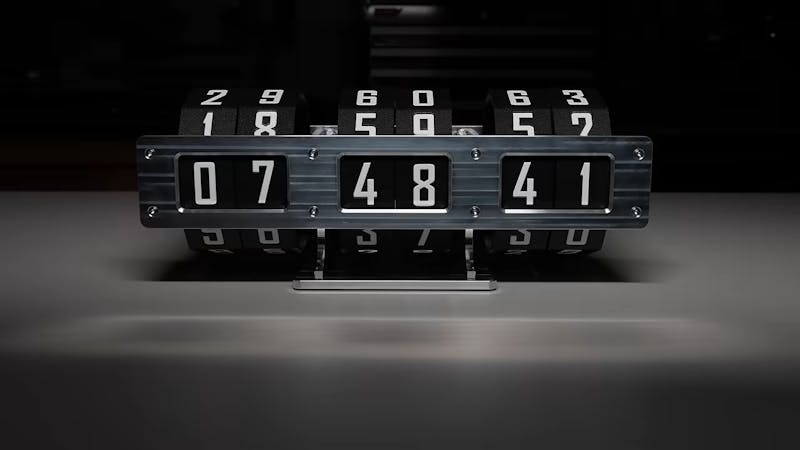
A clock that never needs setting, never drifts, and announces the hour by physically rotating machined aluminum wheels — that is what Clough42 handed over at Toolroom Takeover 2026. The catch is that the thing everyone calls “electromechanical” is running a microcontroller, a GPS receiver, and two stepper drivers underneath the brass-and-aluminum shell.
James (Clough42) built the clock as a gift for fellow YouTube machinist Rowan of Not an Engineer. Most gifts in that exchange are purely mechanical — a vise, a fixture, something turned on a lathe. This one keeps its own time by listening to satellites. A u-blox GPS module pulls the timestamp riding along inside every GPS signal, which is the same atomic-clock-derived time the whole constellation broadcasts. The clock has no navigation function at all; it just wants the seconds.
Pico, GPS, and two TMC2208s
A Raspberry Pi Pico sits at the middle of it. The RP2040 runs its dual Cortex-M0+ cores at 133 MHz, which is far more headroom than a clock needs, but it gives you two hardware UARTs — one for the GPS module, one free for debugging. The u-blox board streams NMEA sentences at 9600 baud on 3.3V logic, so it wires straight to the Pico‘s GP0/GP1 pins with no level shifter.
Turning the numbered wheels falls to a pair of TMC2208 stepper drivers. Those are the quiet ones — the StealthChop mode in the TMC2208 pushes switching noise above hearing range, so a clock sitting on a desk does not buzz every minute. Microstepping down to 1/256 also means each wheel can creep into position without visible stepping. A small display and two buttons let Rowan pick a time zone and flip between 12-hour and 24-hour readouts, which is the part that makes this mechatronics rather than a split-flap.
The metalwork matters too. Several parts came off James’s heavily modified Precision Matthews PM-728 mini mill, now running a Masso controller, with the rest 3D-printed.
Build it yourself
The electronics half of this project is genuinely approachable for a capstone team. A Raspberry Pi Pico, a NEO-6M GPS breakout, two TMC2208 modules, two NEMA 17 steppers, and a 128×64 OLED will get you a working prototype on a breadboard before you machine anything. The gotcha most people hit: TMC2208 boards need their UART pin configured or they silently fall back to the jumper-set microstep resolution, and a GPS module can take 30 seconds or more for a cold fix indoors, so test near a window with the antenna pointed at open sky.
Watch the build log on Hackster, then start with the GPS half alone — get NMEA sentences printing over serial before you connect a single stepper.
Frequently Asked Questions
How does this clock set its own time?
A u-blox GPS module receives NMEA sentences from the satellite constellation, each carrying a precise timestamp derived from atomic clocks. The Raspberry Pi Pico parses that timestamp over UART at 9600 baud and uses it as the reference, so the clock never drifts and never needs manual setting.
What parts would I need to recreate the electronics?
A Raspberry Pi Pico, a NEO-6M or similar u-blox GPS breakout, two TMC2208 stepper driver modules, two NEMA 17 steppers, a small OLED display, and two pushbuttons for the time zone and 12/24-hour settings. The machined aluminum body is optional; a 3D-printed or acrylic frame works for a prototype.
What will I learn if I build this?
You will practise UART serial communication and NMEA sentence parsing, stepper motor control with microstepping drivers, and closed-loop-style homing so the wheels know their zero position at power-up. It also teaches power budgeting, since steppers and a 3.3V logic board have very different current needs, plus enough mechanical design to couple a motor shaft to a rotating display wheel.
