
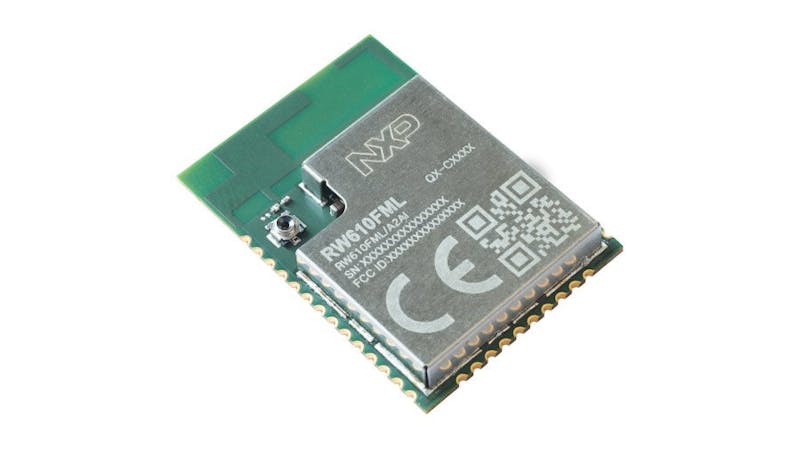
A single module that carries Wi-Fi 6, Bluetooth Low Energy, and its own 260MHz microcontroller changes what a “wireless add-on” can be. NXP’s new RW610FML does exactly that, folding the radio and a full Arm Cortex-M33 core into one part small enough to drop onto a sensor node or a classroom robot.
What NXP actually built
The RW610FML is a combo module built around the RW610 system-on-chip. It speaks IEEE 802.11a/b/g/n/ac/ax for Wi-Fi 6 and Bluetooth LE in the same package, so one part handles both radios instead of bolting on two separate chips. The interesting twist for makers is that the on-board Cortex-M33 can either sit quietly as a communications coprocessor next to your main MCU, or run the whole show itself and drive your hardware directly. That flexibility means a thesis project could start with the module offloading Wi-Fi from an existing Arduino, then later collapse into a single-chip design once you trust the RW610 to handle GPIO, PWM, and sensor reads on its own.
The specs that matter
The Cortex-M33 runs at up to 260MHz with 1.2MB of on-chip SRAM and 8MB of flash, plus quad-SPI execute-in-place support if you want to run code straight from external flash. The Wi-Fi 6 radio is a 1×1 dual-band design covering 2.4GHz and 5GHz at 20MHz channel width, peaking at 114Mb/s, while the BLE side hits 2Mb/s in high-speed mode. Peripheral coverage is generous: SDIO 3.0, USB, UART, I2C, SPI, I2S, ADCs and DACs, an analog comparator, and JTAG plus SWD for debugging. There is even an LCD interface and a microphone input, which opens the door to voice or display projects without extra breakout boards.
Build it yourself
The part is still in pre-production, so pricing has not been posted yet. If you want to prototype now, NXP pairs the module with a carrier board called the FRDM-RW610FML that breaks out the peripheral pins for easy breadboard and jumper access. A practical first build: wire an I2C temperature sensor to the module, publish readings over MQTT on your school Wi-Fi, and use the spare BLE radio to push the same data to a phone. Watch the 3.3V logic levels on your sensor lines, and check the pull-up requirements on the I2C bus before you power up. Full details on both the module and the FRDM board are on NXP’s product page.
Frequently Asked Questions
What radios does the NXP RW610FML support?
It combines a Wi-Fi 6 1×1 dual-band radio (2.4GHz and 5GHz, up to 114Mb/s) with Bluetooth Low Energy at up to 2Mb/s, all in a single module so you don’t need two separate chips.
Can the RW610FML run a project on its own, or does it need a host MCU?
Both work. Its on-board 260MHz Arm Cortex-M33 can act as a communications coprocessor next to your main microcontroller, or drive the hardware directly using its GPIO, PWM, I2C, and SPI peripherals.
What will I learn if I build with this module?
You’ll practice wiring an I2C sensor, watching 3.3V logic levels and I2C pull-ups, publishing data over MQTT on Wi-Fi, and pushing the same readings over BLE, skills that carry straight into IoT thesis and capstone work.
