
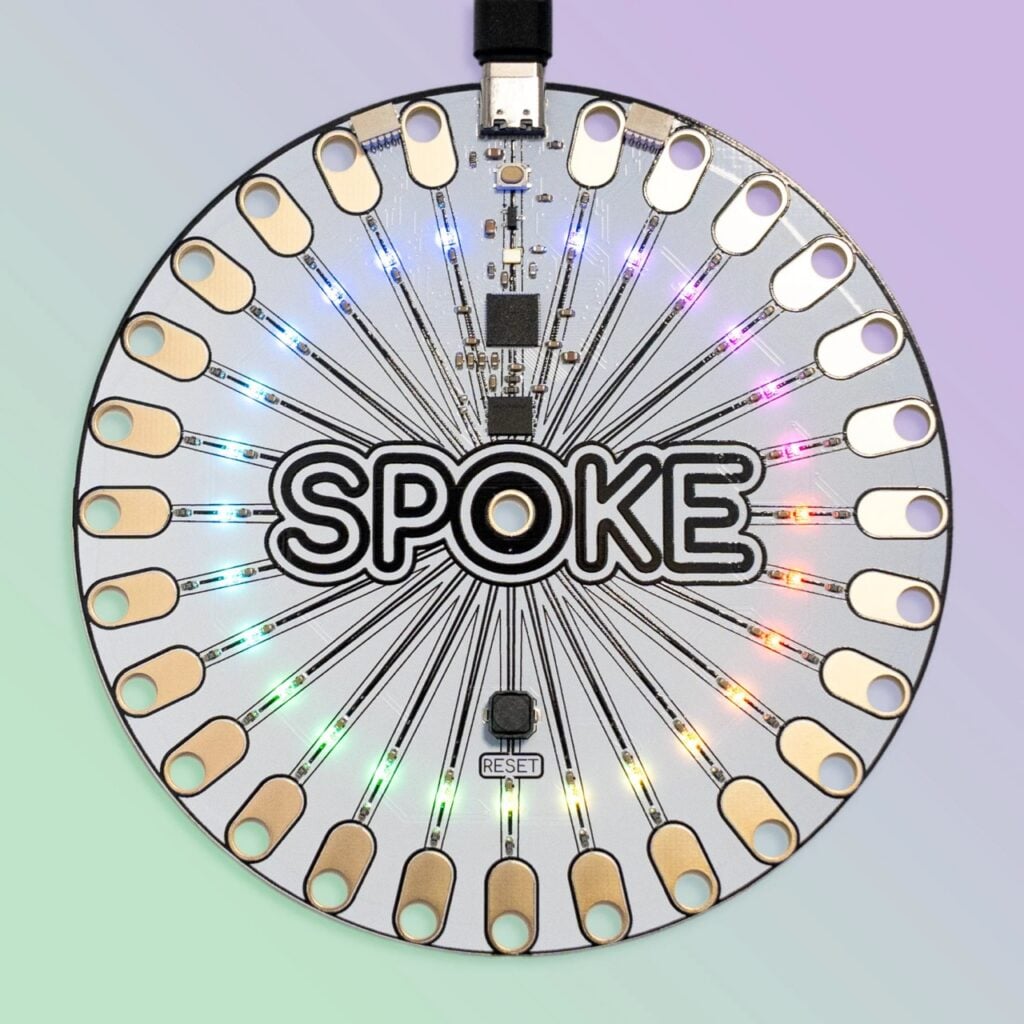
Cheap microcontrollers have quietly turned music-making into a hardware hobby. Boards built around the RP2040 now sit at the center of homemade synths, MIDI pads, and touch instruments that would have cost hundreds a decade ago. The SPOKE fits right into that wave: a CD-sized board covered in capacitive touch pads that plays a note the moment you brush a finger across it.
What the SPOKE actually is
The SPOKE looks like a 1990s indie album, cardboard sleeve art and all, but its 27 copper touch pads each wire to a GPIO pin on an onboard RP2040 chip. Plug it into a computer over USB-C and the default firmware registers as a standard MIDI controller. Head to spokeboard.com, grant your browser MIDI access, and every pad triggers a note. The site layers on audio visualisers, a Harmonic Table that maps 100 polygons to notes, a one-shot drum kit, and an Audio Playground for loading clips from Freesound.org or your own recordings.
The technical bits worth knowing
Because the firmware runs CircuitPython, you program the SPOKE exactly like a Raspberry Pi Pico, editing code in Thonny or the browser-based Code Playground over serial. The pads default to a pentatonic scale, five notes per octave, and you change that by editing note values in the default program. Two Qwiic / STEMMA QT ports let you bolt on extra sensors, though wiring them up disables a couple of pads. Each pad also drives a NeoPixel that shifts colour on touch. One gotcha: press the Reset button to recalibrate touch sensitivity whenever you connect something new.
What to try next
The real fun starts when you extend the pads with anything conductive. Copper tape, conductive thread, pencil graphite, even crocodile clips onto a banana all register as touch inputs, so a bowl of fruit becomes a drum kit. From there, load an arpeggiator or step sequencer from the code examples, or remap the scale for your own track. If you would rather build the concept from scratch, a Raspberry Pi Pico plus a few copper pads and CircuitPython’s touchio library gets you most of the way. Full details and every play mode are on the original write-up at raspberrypi.com.
Frequently Asked Questions
What microcontroller powers the SPOKE?
An RP2040, the same chip found in the Raspberry Pi Pico. Its 27 capacitive touch pads each connect to a GPIO pin, and the board talks to your computer as a USB-C MIDI controller.
Do I need to solder anything to make music with it?
No. Out of the box the SPOKE works as a plug-and-play MIDI controller through spokeboard.com. To extend the pads you clip conductive materials like copper tape or fruit to them, then press Reset to recalibrate the touch sensitivity.
What will I learn if I build this?
You get hands-on with capacitive touch sensing, GPIO mapping, and CircuitPython programming, plus the basics of MIDI and how NeoPixels respond to input. It is a friendly way to connect coding with real sound output.
