
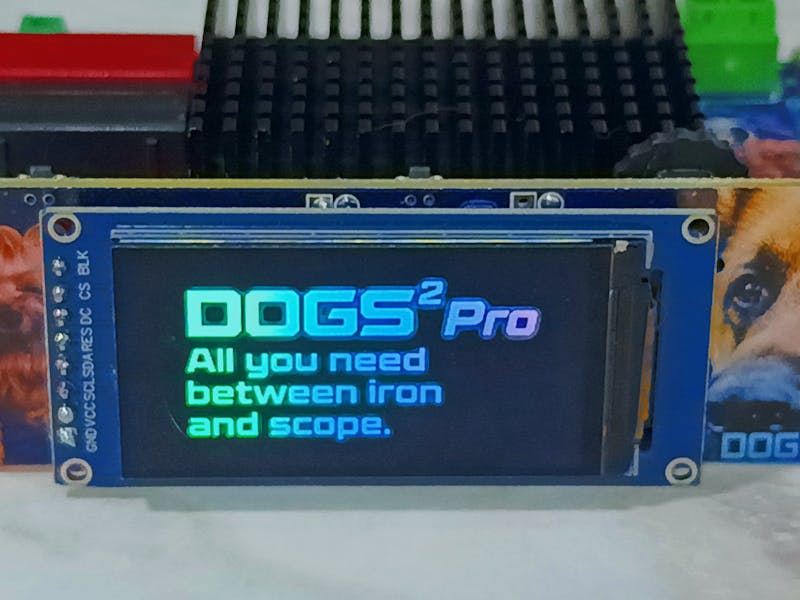
Some builds are made for a weekend: enough of a challenge to keep you at the bench past lunch, but scoped tightly enough that you can flip the power on before Sunday dinner. A maker named Sergei packed an entire test bench into one palm-sized gadget called DOGS2, and the design files are open, so it makes a great two-day project.
What Sergei crammed into one box
DOGS2 fits in your hand but swallows half a workbench worth of instruments. Inside a single enclosure you get a dual-channel programmable power supply, a logic probe, a frequency counter, a signal generator, and protocol sniffers for UART, RS485, CAN, and I2C. About the only thing missing is an oscilloscope. Power comes from 5-90V DC or straight off USB-C, with protection against overvoltage, reverse polarity, and inrush current built in.
The specs are not toy-grade either. Channel one uses a low-noise linear regulator good for 20V at 1.5A. Channel two runs a DC-DC converter that pushes 48V at 3A continuously, or 5A in short bursts, and both channels monitor their own current draw. The logic probe reads up to 25V, the frequency counter tracks signals to 100kHz, and the signal generator produces square waves from 1Hz to 100kHz at up to 20V 1A.
Parts reality before you start
DOGS2 is two boards: a main power board and a control panel driven by an ESP32-WROOM. The panel carries an LCD, physical buttons, and Bluetooth, so you can drive the whole thing from your phone and keep the bench clear. The ESP32-WROOM is the cheap part here, usually a few hundred pesos at circuit.rocks. The real cost sits in the power section, where the connectors, the DC-DC converter, and the regulators add up. Budget for careful solder work too, because the high-current traces on that power board are not where you want a cold joint.
- Control brain: ESP32-WROOM with LCD and Bluetooth
- Input: 5-90V DC or USB-C, fully protected
- Outputs: 20V 1.5A linear plus 48V 3A switching
Spend your Sunday on this
Sergei has a working first version and plans to iterate after more testing, so treat the current design as a solid v1 rather than a finished product. Pull the schematics and board files from the build writeup at Hackster, order your ESP32-WROOM, and give your bench one box to replace the other five.
Frequently Asked Questions
What microcontroller runs DOGS2?
The control panel board is built around an ESP32-WROOM module, which drives the LCD, reads the physical buttons, and adds Bluetooth so you can control the instrument from a phone.
How much power can DOGS2 deliver?
Two channels: a low-noise linear regulator rated 20V at 1.5A, and a DC-DC converter rated 48V at 3A continuous (up to 5A briefly). It accepts 5-90V DC or USB-C input, all with overvoltage and reverse-polarity protection.
What will I learn if I build this?
You practice mixed-signal PCB design, the difference between linear and switching power regulation, current sensing, and writing ESP32 firmware to drive an LCD and Bluetooth interface. Bringing up the protocol sniffers also teaches you UART, I2C, and CAN at the wire level.
