
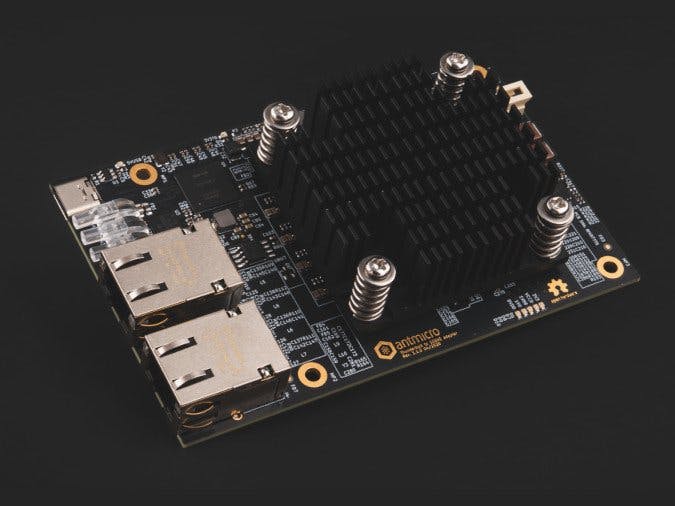
Open hardware keeps chipping away at the line between buying a finished board and studying how it was actually made. A growing number of companies now publish full circuit sources, not just marketing photos, so anyone with the right software can inspect every trace and pad. Antmicro’s latest release lands squarely in that trend: the company posted the complete KiCad project files for a dual-port 10-gigabit-Ethernet card that talks to a host over Thunderbolt.
What Antmicro actually shipped
The board is a Thunderbolt-to-dual-10GbE adapter, released under a permissive license so you can copy, remix, or fabricate it without asking permission. It exposes two independent Ethernet interfaces tunneled over a single Thunderbolt 3.0 link, which carries up to 40Gb/s and can daisy-chain as many as 6 devices from one host. One port can handle local high-bandwidth traffic to an attached device while the second faces the wider network. It plugs in through the same USB-C connector most Thunderbolt gear already uses.
Why the KiCad files matter
Ethernet has climbed a long way since its 10Mb/s coax days at Xerox PARC in the 1970s, through 100Mb/s Fast Ethernet, up to links that now reach 400Gb/s. Routing 10GbE by hand is not beginner territory. You are dealing with controlled-impedance differential pairs, careful ground planes, and connector footprints that punish sloppy layout. A working reference design in KiCad lets you open the schematic, follow how the PCB handles those high-speed pairs, and learn from decisions a professional team already validated. Antmicro pitches it as a starting point for custom builds, from smart cameras to point-of-sale terminals and IoT gateways.
What to try next
You do not need a 10GbE board to get value here. Open the files in KiCad, which is free, and treat the layout as a study guide for differential routing and impedance control. If you are running a school PCB unit or a thesis project, a permissively licensed reference like this beats a locked-down datasheet. The full write-up and the KiCad sources are linked from Hackster’s coverage: https://www.hackster.io/news/antmicro-adds-to-its-open-hardware-portfolio-releases-kicad-sources-for-a-thunderbolt-10gbe-nic-35b60efc41e9
Frequently Asked Questions
How does this card connect to the host computer?
It links over a single Thunderbolt 3.0 interface on a USB-C connector, carrying up to 40Gb/s, and enumerates two independent 10-gigabit-Ethernet ports on the host side.
Do I have to pay or ask permission to modify the design?
No. Antmicro published the complete board as KiCad project files under a permissive license, so you can copy, remix, or fabricate your own version freely as a reference design.
What will I learn if I build or study this design?
You will pick up high-speed PCB skills that transfer everywhere: routing controlled-impedance differential pairs, planning ground planes, placing connector footprints, and reading a real production schematic in KiCad.
