
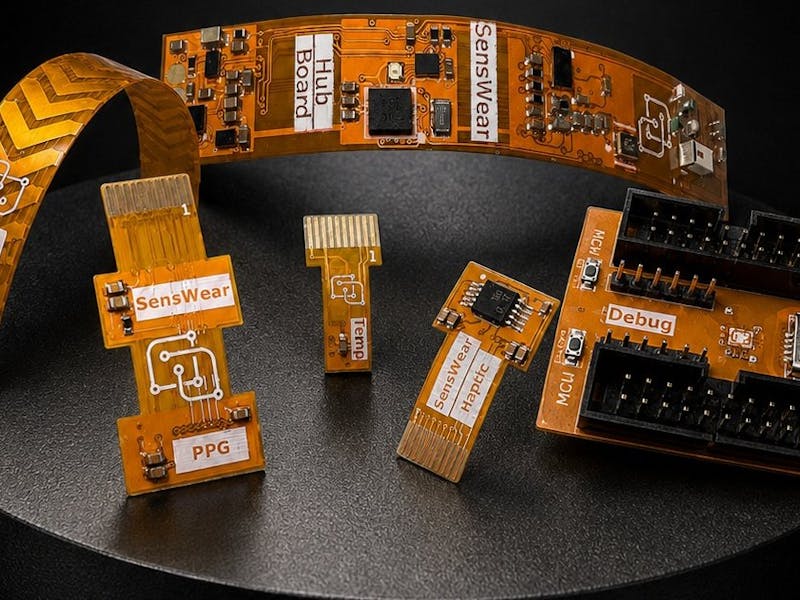
Smart rings, health-monitoring patches, and fitness bands land on crowdfunding pages almost every month, and behind nearly all of them sits the same slow grind: design a custom board, write the firmware, build a companion app, then wire up something to log and read the sensor data. An open source project called SensWear tries to collapse that whole pipeline into one kit.
What SensWear actually is
SensWear is a modular wearable development platform that splits the core electronics from the sensors. The main board carries the radio and processor, and interchangeable daughter boards add whatever sensing you need. You can swap a heart-rate module for a temperature sensor without touching the main design, and standardized connectors let you daisy-chain several boards into one prototype. Every layer ships under the MIT license: PCB design files, firmware, the Android and iOS apps, and the SDKs.
The parts that matter
The board is built around Nordic’s nRF54L15 SoC, which pairs a 128 MHz Arm Cortex-M33 with a RISC-V coprocessor for software-defined peripherals, plus 256 KB of SRAM and 1.5 MB of non-volatile storage. It speaks Bluetooth LE 6.0, Thread, Zigbee, and Matter. An onboard Bosch BHI360 six-axis IMU handles motion sensing. The daughter boards cover the usual wearable jobs: a MAX30101 optical sensor for PPG heart-rate and blood-oxygen readings, a MAX30208 temperature sensor, an MTCH6102 capacitive touch controller with 15 channels, and a DRV2605 haptic driver for vibration feedback. Firmware runs on the Zephyr RTOS, while Python and TypeScript SDKs stream time-synchronized sensor data straight into your own signal-processing or machine-learning code.
What to try next
The catch is price. A full bundle runs about $975, the core board alone is $800, and each daughter board is $115, which aims squarely at research labs rather than a student allowance. But the parts list doubles as a shopping guide you can copy on a budget. Pair an ESP32 with a MAX30102 breakout over I2C and you have a working PPG heart-rate rig for a fraction of the cost, and a solid thesis starting point. Read the full write-up on Hackster and browse the design files in the project’s GitHub repository, then pick the one sensor you want to build your first prototype around.
Frequently Asked Questions
What can SensWear’s sensor modules measure?
The daughter boards cover common wearable signals: a MAX30101 optical sensor for PPG heart-rate and blood-oxygen, a MAX30208 temperature sensor, an MTCH6102 15-channel capacitive touch controller, and a DRV2605 haptic driver. The onboard Bosch BHI360 IMU adds six-axis motion sensing, and boards can be daisy-chained to combine them.
How much does the SensWear platform cost?
A full bundle with the core board, four daughter boards and a debug board is about $975. The core board on its own is $800, and each daughter board is $115. It targets research and product-development teams rather than hobbyist budgets, but the parts list is easy to recreate cheaply.
What will I learn if I build a wearable like this?
You practice the full embedded stack: reading a PPG or IMU sensor over I2C, writing firmware on a real-time OS like Zephyr, streaming data over Bluetooth LE, and processing the signal in Python. Those skills carry straight into a thesis, a robotics team, or a health-tech capstone.
