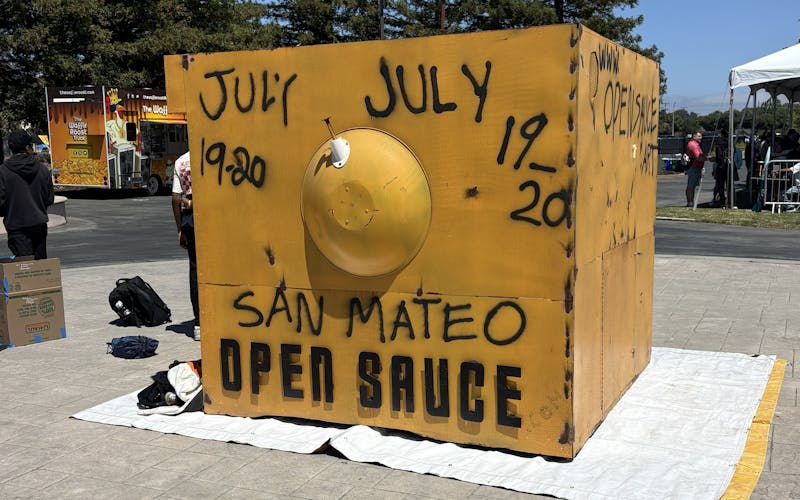
Walking the Open Sauce 2026 show floor, Hackster community lead Joel Bados landed on seven takeaways. The one worth acting on this weekend is simple: almost every crowd-stopping build started as a personal project someone hacked together in their spare time. You do not need a booth or a budget to join in, just a free Saturday and a couple of cheap boards.
What the makers actually built
The standouts were not the biggest projects, they were the cleverest. A telephone by creator @hillxry uses an AI model to “call you from the future” based on a few of your answers. Hackster Pro Cameron Coward wired a vintage typewriter to a language model, so it types back replies to whatever you ask it. Acronym rolled out a T-shirt launcher that had a laughing queue every time it fired. Different scales, same DNA underneath: a microcontroller, a sensor or two, and one good idea that someone bothered to finish.
The parts reality, cheaper than the show floor lets on
Here is what the polished booths hide. Most of these builds run on hardware you can hold in one hand. An ESP32 dev board sells for around 300 PHP and gives you Wi-Fi, Bluetooth, and roughly 25 usable GPIO pins. Reach for a Raspberry Pi 5 only when you need real horsepower for on-device AI. A typewriter-answers-questions clone is a USB keyboard, a Pi, and one API call. The future-phone is a handset, a microphone, and an ESP32 posting to a chatbot. None of it needs a 3D printer or a lab bench. A breadboard, a fistful of jumper wires, and a 5V supply cover the whole starter kit.
Spend your Sunday on one
Pick the smallest version of a project that made you smile. Wire an ESP32 to a small microphone and a 128×64 OLED, and get it to answer one silly question out loud. Watch the SDA and SCL lines on the I2C display, since a swapped pair is the classic first-hour gotcha that eats an afternoon. Flash the code, tweak the address if the screen stays dark, and you have your own tiny Open Sauce booth sitting on your desk. Read Joel’s full seven-things recap over at Hackster, then go dig the breadboard out of the drawer.
Frequently Asked Questions
What kind of projects showed up at Open Sauce 2026?
A wide mix: an AI telephone that ‘calls you from the future,’ a typewriter wired to a language model that types back answers, robots that learn from human movement, and lighter builds like a T-shirt launcher. Most were personal passion projects built in spare time.
How much does it cost to start a build like these?
Less than the booths suggest. An ESP32 dev board runs about 300 PHP with Wi-Fi and roughly 25 GPIO pins, and a breadboard, jumper wires, and a 5V supply round out a starter kit. Step up to a Raspberry Pi 5 only when a project needs on-device AI horsepower.
What will I learn if I build one of these projects?
You practice the core embedded skills: wiring a microcontroller to sensors and an I2C display, getting SDA and SCL right, flashing firmware, and calling an API. Those transfer straight into thesis builds, robotics competitions, and any IoT project you tackle next.
