
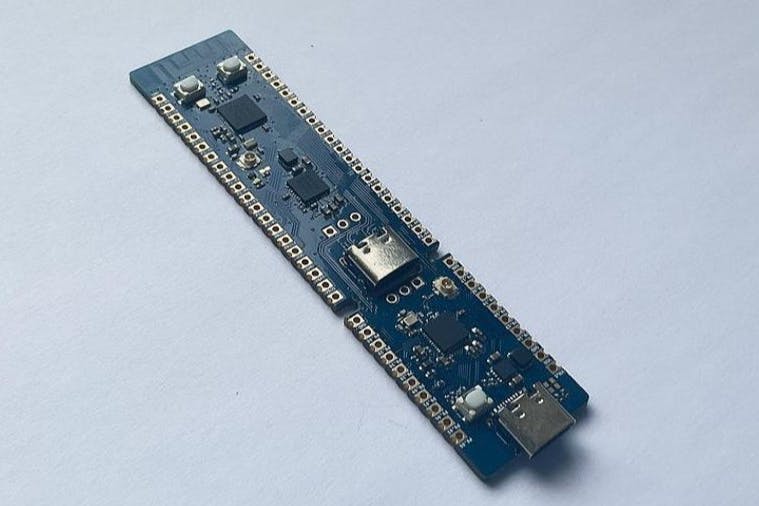
Wireless microcontrollers used to force a trade-off: pick one radio stack, keep the clock speed modest, and budget for a separate debugger. The newer Nordic nRF54 family is quietly rewriting that math, and Icy Electronics’ nRF54L15 Discovery board is a neat snapshot of where affordable open hardware is heading, multi-protocol radios, a RISC-V coprocessor, and a programmer you don’t pay extra for.
Two boards on one PCB
The Discovery ships as two separate designs joined by mouse-bite bridges. Snap them apart and you get an nRF54L15 development board plus a standalone nRF52820 programmer, each carrying its own USB Type-C port and voltage regulator. Straight out of the box the nRF52820 runs CMSIS-DAP firmware, so it flashes and debugs the main chip over SWD with a UART bridge for serial logging, no external probe required. That is the “two boards for the price of one” pitch: once your project is stable, the programmer half can be reflashed and reused as a general-purpose BLE board.
What is actually inside
The nRF54L15 is the star. It pairs a 128MHz Arm Cortex-M33 with a second 128MHz core built on the open RISC-V architecture, backed by 256kB of SRAM and 1.5MB of non-volatile RAM. Its 2.4GHz radio covers Bluetooth Low Energy, IEEE 802.15.4 (the layer under Thread and Zigbee), and Nordic’s proprietary modes at up to 4Mb/s. The nRF52820 half is no filler part: it runs a Cortex-M4 at 64MHz with 32kB of SRAM and 256kB of flash, and its GPIO lines break out to castellated 0.1″ headers along the long edges, so you can solder it straight onto a carrier board.
What to try next
At $27.19 on Lectronz, it is cheap enough to leave one half permanently wired as your debugger and hand the other to a project. The full KiCad design files sit on GitHub under the CERN Open Hardware License, so you can fork the layout and spin your own variant instead of starting from a blank schematic. For a robotics or thesis team, a sensible first build is BLE sensor telemetry running on the M33, then pushing always-on jobs like packet timestamping onto the RISC-V coprocessor once the basics behave.
Frequently Asked Questions
Do I need a separate debugger to program the nRF54L15 Discovery?
No. The bundled nRF52820 half ships pre-flashed as a CMSIS-DAP programmer and debugger, connecting over USB and bridging to the main chip via SWD and UART, so there is no external probe to buy.
What does the board cost and are the design files open?
It sells for $27.19 on Lectronz before volume discounts, and the KiCad design files for both boards are published on GitHub under the CERN Open Hardware License 2.0, so you can study or fork the layout.
What will I learn if I build with this board?
You will get hands-on with SWD debugging, multi-protocol 2.4GHz radios (BLE and IEEE 802.15.4), and splitting work across a Cortex-M33 and a RISC-V coprocessor, plus practical PCB skills like using castellated headers and reflashing a spare MCU for a new role.
