
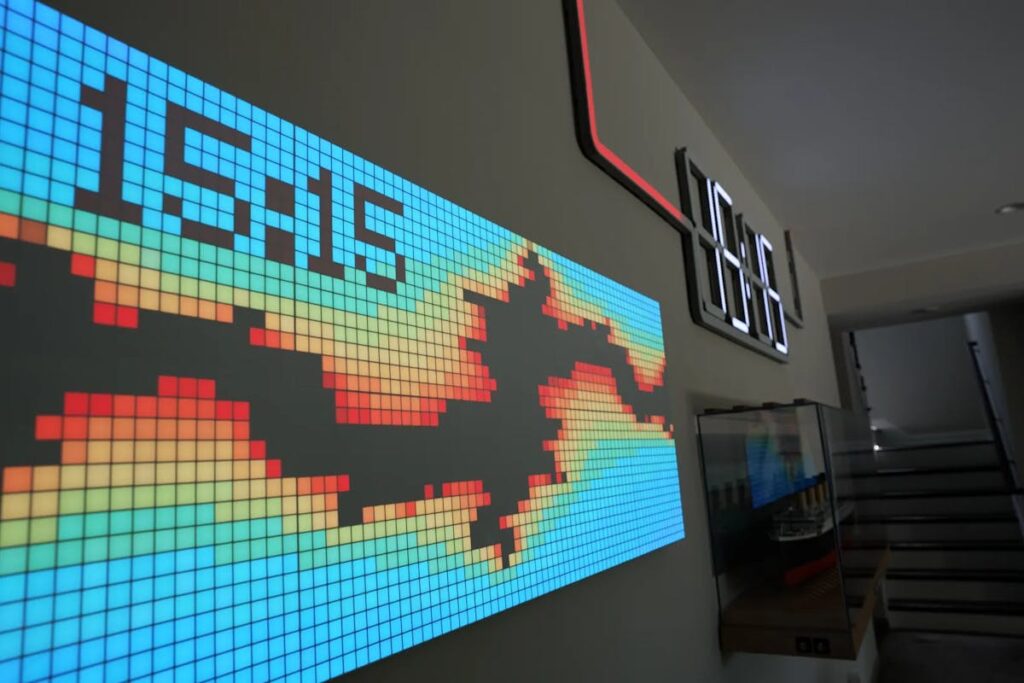
A blank wall is just pixels waiting to happen. Andy Huot’s Duality Canvas system turns that idea into hardware you can actually build: a frameless LED display that scales to whatever size your wall happens to be. No proprietary panel, no fixed resolution, just square RGB pixels roughly half an inch across that you tile until the wall is full.
What the Duality Canvas actually is
The build is a grid of “dumb” PCB panels, each one a 16×16 array of individually addressable LEDs. A single panel carries nothing but the LEDs, a few screw terminals, and one capacitor to smooth out power delivery. Everything clever happens off-board: separate controller modules mount to the back and feed power and data to the panels that need them. Because every pixel is individually addressable, the whole wall runs on WLED, so you get animations, scrolling effects, and overlays like a live clock without writing firmware from scratch.
The technical details worth knowing
Modularity is the real trick. You grow the display in multiples of 16 LEDs, snapping panels together with printable brackets and mounts. Data coordination comes from a GLEDOPTO ESP32-based WLED controller with four output channels; if you need more, the QUINLED Dig-Octa Brainboard pushes that to eight. Power distribution rides on WAGO connectors instead of solder joints, which keeps a big wall serviceable when one panel misbehaves. The 16×16 constraint is not arbitrary either, it maps cleanly onto how WLED addresses segments, so laying out your wall in software stays sane.
Build it yourself
Huot had his panels fabricated and assembled at JLCPCB for about $40 each, LEDs included. A 2×4-panel wall lands around $400 to $500 once you add power supplies, connectors, and mounting hardware, and bulk-ordering panels drops the per-unit cost on bigger builds. The design files sell for $30 on Printables, and the full write-up lives on Hackster. If you are an ECE or robotics student, this makes a strong capstone: you touch PCB sourcing, 5V power budgeting across many amps, addressable-LED data timing, and a real software layer in WLED. Start with a single 16×16 module, get one ESP32 controller talking to it, then scale.
Frequently Asked Questions
What controls the LEDs in the Duality Canvas wall?
Each 16×16 panel is passive, holding only LEDs, screw terminals, and a smoothing capacitor. A GLEDOPTO ESP32 WLED controller with four channels feeds power and data from the back, and you can swap in a QUINLED Dig-Octa Brainboard for eight channels on larger walls.
How much does it cost to build?
Panels run about $40 each assembled at JLCPCB. A 2×4-panel wall totals roughly $400 to $500 with power supplies and connectors, and the design files are $30 on Printables. Bulk ordering panels lowers the per-panel price.
What will I learn if I build this?
You practice PCB sourcing and assembly, 5V high-current power distribution with WAGO connectors, addressable-LED data timing, and configuring WLED segments in software, all skills that carry over to any large embedded display project.
