
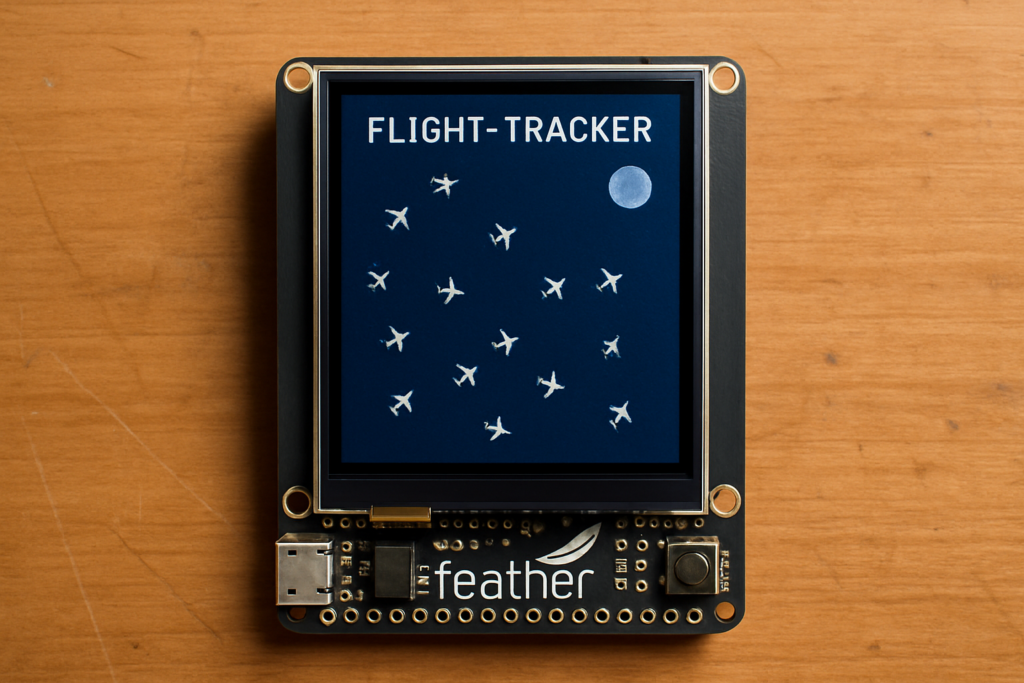
Got a free Saturday and a window that faces the sky? On this week’s Adafruit workbench, Pedro built a desktop flight tracker that does something most trackers skip: it predicts the moment an aircraft crosses in front of the Moon. It runs quietly on a shelf, and you can get it stacked and blinking in an afternoon.
What the tracker actually does
The build runs on the Adafruit Feather RP2350 with 8MB of PSRAM, paired with the 3.5-inch TFT FeatherWing V2 and its bright 480×320 screen. Live aircraft positions scroll across the display, and the lunar-transit feature flags the seconds when a plane’s path lines up with the Moon’s position in your patch of sky. That alignment is the shot astrophotographers hunt for, a black airplane silhouette crossing a full Moon.
How it comes together
The RP2350’s two cores run at 150MHz, and the 8MB PSRAM earns its keep here: it holds map tiles and a full framebuffer without starving the rest of the sketch. The transit prediction is plain trigonometry, comparing each aircraft’s bearing and altitude against the Moon’s azimuth and elevation for your latitude and longitude. The FeatherWing stacks straight onto the Feather’s headers over SPI plus a couple of control GPIO lines, so if you buy pre-populated stacking headers there is no soldering at all. One gotcha: if you pile on more FeatherWings later, check the pin overlap so nothing fights the TFT for those SPI lines.
Parts and cost reality
You need three things: the Feather RP2350 (product 6130), the 3.5-inch TFT FeatherWing V2 (product 3651), and a set of stacking headers. Add a USB-C cable for power and you have a two-board stack that sits flat on a shelf. No enclosure required to get it running, though it is an obvious next print.
Spend your Sunday on the upgrade
Want more from the weekend? The same episode wraps up a CircuitPython chiptune player built around the PCM5102 I2S DAC, so Sunday’s job could be wiring in an audio chirp that fires the instant a transit is about to happen. Start from the Feather RP2350 board page at https://www.adafruit.com/product/6130 and follow the livestream recap for the wiring order.
Frequently Asked Questions
How does the tracker know when a plane will cross the Moon?
It runs trigonometry on live data, comparing each aircraft’s bearing and altitude against the Moon’s azimuth and elevation for your latitude and longitude, then flags the seconds when the two line up.
What boards do I need to build this?
An Adafruit Feather RP2350 with 8MB PSRAM (product 6130), the 3.5-inch TFT FeatherWing V2 with its 480×320 screen (product 3651), a set of stacking headers, and a USB-C cable for power.
What will I learn if I build this?
You will practice driving an SPI TFT display, doing coordinate and azimuth/elevation trig, managing memory with external PSRAM, and parsing live positional data on a microcontroller, all transferable to robotics and IoT projects.
