
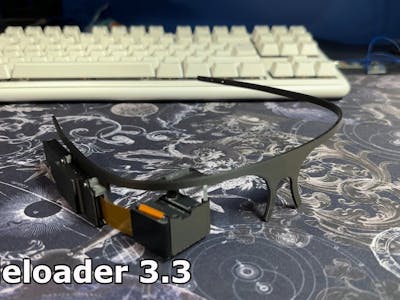
Got a spare weekend and a steady soldering hand? Maker Mañolo’s Sideloader 3.3 is the kind of build that fits neatly between Saturday breakfast and Sunday dinner. It squeezes a homemade augmented-reality headset that talks to SteamVR, with native head tracking, into a shape you can actually wear without a headache.
The headset overlays the SteamVR interface straight onto your view of the room. Turn your head and the floating menu stays anchored in space, because an onboard inertial measurement unit (IMU) reports real-time rotation back to the PC. Earlier revisions leaned on an off-the-shelf microcontroller board. Version 3.3 drops that entirely and solders a bare ATmega32u4 chip directly onto a custom PCB, shrinking the electronics down to something that hides inside the frame.
What you’d actually need
- A bare ATmega32u4, the same 8-bit, 16 MHz chip inside an Arduino Leonardo, with native USB so you skip a separate programmer
- A custom PCB, or a protoboard if you want to breadboard the circuit first
- An IMU wired over I2C (SDA and SCL, plus two pull-up resistors)
- A miniature display and a semi-transparent plastic sheet for the optical combiner
- A 3D-printed headband with a slot for the board and one self-tapping screw acting as an adjustable hinge
The fiddly part is the optics, not the firmware. Mañolo cut the combiner from a clear plastic sheet using a printed template, then cleaned up the edges with a rotary tool. Angled in front of the display, it bounces the image into your eye while staying see-through, giving you that floating overlay AR is known for. The sensor gets insulated first so a stray pad doesn’t short it, then glued in and jumpered to the board.
Spend your Sunday on this one if you like wearables and low-level embedded work. Start by getting the ATmega32u4 to enumerate over USB and reading the IMU on a breadboard, then move to the PCB once the numbers look sane. Calibrate with the classic figure-eight wave before SteamVR picks up the rotation. Full build notes and the video are on Hackster: the Sideloader 3.3 write-up.
Frequently Asked Questions
How does the Sideloader 3.3 headset track head movement?
An onboard inertial measurement unit (IMU) wired over I2C reports real-time rotation to the PC, so SteamVR keeps the floating overlay anchored in space as you turn your head. You calibrate it with a figure-eight motion before use.
What microcontroller runs the headset, and do I need a separate programmer?
It uses a bare ATmega32u4, the 8-bit, 16 MHz chip found in the Arduino Leonardo, soldered directly onto a custom PCB. Because the ATmega32u4 has native USB, you flash firmware straight over a USB cable without an external programmer.
What will I learn if I build this?
You’ll practice reflow or fine soldering on a bare chip, wiring an I2C sensor with proper pull-ups on SDA and SCL, uploading and calibrating firmware over USB, and the basics of optical combiners for augmented reality. It’s a solid crossover project between embedded electronics and wearables for a thesis or robotics-club portfolio.
