
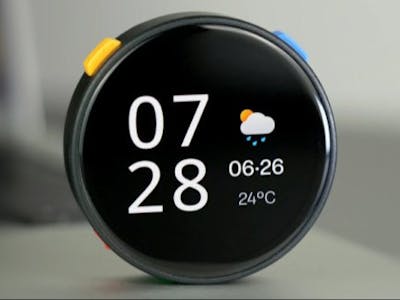
Round screens look great. Wearables look great. Combine them with an ESP32-S3 and a 450 mAh battery, and you have something most makers can actually build with — that’s exactly what M5Stack is pitching with its new StopWatch Dev Kit.
Shaped like a chunky sports stopwatch, the board is aimed at developers who want a self-contained, pocket-sized platform for wearable interaction projects, electronic badges, or lightweight IoT terminals. Instead of taping a dev board to a 3D-printed shell, you get a finished round housing with two user-programmable side buttons, a dedicated power button, and a charging-ready battery already inside.
What’s under the AMOLED
The brain is an Espressif ESP32-S3R8, a dual-core 32-bit Tensilica Xtensa LX7 microcontroller that runs at up to 240 MHz with 8 MB of PSRAM and 16 MB of program flash on board. That’s paired with a 1.75-inch circular full-color AMOLED touchscreen, an RX8130CE real-time clock for accurate timekeeping, a Bosch Sensortec BMI270 six-axis IMU for motion and gesture input, a MEMS microphone, an audio codec with a built-in amplified speaker, and a haptic vibration motor for tactile feedback. Power is handled by M5Stack’s M5PM1 management system feeding the 450 mAh cell. Wi-Fi on 2.4 GHz is supported; BLE is hardware-capable but isn’t listed in the current firmware spec.
To push it further, the case includes an HY2.0-4P expansion connector plus two rear expansion headers, so add-on sensors or GPIO modules are easy to wire in. The kit is listed at $45 on the M5Stack store.
Build it yourself
To prototype something similar from individual parts, you’d want an ESP32-S3 module (the S3R8 with PSRAM is ideal if you’re driving a full-color display), a round AMOLED touch panel, a BMI270 IMU breakout, an RX8130CE-compatible RTC, a MEMS microphone, an I2S audio codec or amp with a small speaker, a haptic motor, and a Li-Po pack with a charging IC. Expect plenty of bring-up work on the display driver and touch layer, plus careful power planning if you want the device to survive a day on a single charge. That’s exactly what makes the pre-built kit appealing — you can skip straight to writing firmware for your wearable badge, smart timer, or motion-controlled UI demo instead of fighting the hardware first.
Frequently Asked Questions
What microcontroller powers the M5Stack StopWatch Dev Kit?
It runs on an Espressif ESP32-S3R8, a dual-core Tensilica Xtensa LX7 chip clocked up to 240 MHz with 8 MB of PSRAM and 16 MB of flash, plus 2.4 GHz Wi-Fi.
What sensors and I/O are built into the StopWatch?
A 1.75-inch AMOLED touchscreen, a Bosch BMI270 six-axis IMU, an RX8130CE real-time clock, a MEMS microphone, an amplified speaker, a haptic motor, two programmable buttons, and an HY2.0-4P plus rear expansion headers.
What will I learn if I build a project with this kit?
You’ll get hands-on with ESP32-S3 firmware development, driving an AMOLED touch display, reading IMU motion data, integrating an RTC for timekeeping, basic audio I/O, and battery-powered design for wearables — a solid stack of embedded skills in one project.
