
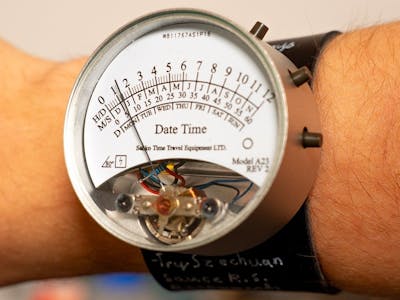
Most digital watches lean on tiny LCD or OLED panels for readouts. YouTuber Sahko went the other way, building a one-of-a-kind wearable that displays time, date, and day of the week using a single sweeping needle salvaged from a vintage analog VU meter.
The watch flips the usual maker-watch formula on its head. Instead of cramming pixels onto a small screen, Sahko prints multiple scales onto a custom dial and lets one moving pointer hop between them. A press of a side button changes mode, so the same needle that just showed the hour can pivot over to a date or day scale on demand. It looks more like a piece of mid-century lab gear than something off a smartwatch shelf, and that is exactly the appeal.
How a single needle becomes a digital display
Behind the dial sits a Raspberry Pi RP2040 microcontroller, the same chip that powers the Raspberry Pi Pico. The RP2040 does the heavy lifting: timekeeping, button handling, and figuring out where the needle should sit for any given reading. A digital-to-analog converter then turns those calculations into precise current changes, and the VU meter’s electromagnetic coil swings the needle to the right spot on the printed scale.
The build was not friction-free. An early plan to add a digital compass was scrapped because the strong magnets inside the analog meter wrecked the compass readings. During assembly the custom dial plate pressed against the delicate needle, so Sahko wound thin coils of wire around the mounting screws as improvised micro-spacers to lift the mechanism by a fraction of a millimeter. The aluminum case was CNC-machined from a solid block, finished with bead-blasted ceramic, and capped with a curved pocket-watch crystal. A rechargeable LiPo cell and USB-C charging circuitry hide inside, and embedded neodymium magnets snap the watch onto a leather-and-elastic strap.
Build it yourself
The core ingredients are surprisingly accessible. You will need a Raspberry Pi RP2040 board (a Pico works as a starting point), a salvaged or new VU meter movement, a small DAC to drive the coil cleanly, a LiPo battery with a USB-C charge controller, and a few tactile buttons for mode switching. The hard part is mechanical: lining up the needle, the printed dial, and the case so nothing rubs.
Frequently Asked Questions
What microcontroller powers this VU meter watch?
A Raspberry Pi RP2040 handles timekeeping, button input, and the math needed to position the needle. A digital-to-analog converter then translates those values into the precise current that swings the VU meter coil to the right spot.
How does a single needle show time, date, and day?
Sahko printed several scales onto the custom dial face. Side buttons let the RP2040 switch between display modes, so the same needle hops between hour, date, and day scales depending on which mode is active.
What will I learn if I build this?
You will get hands-on practice driving an analog meter from a microcontroller via a DAC, designing custom dials, planning LiPo power with USB-C charging, and the mechanical patience of fitting a needle, dial, and CNC case together without binding.
