
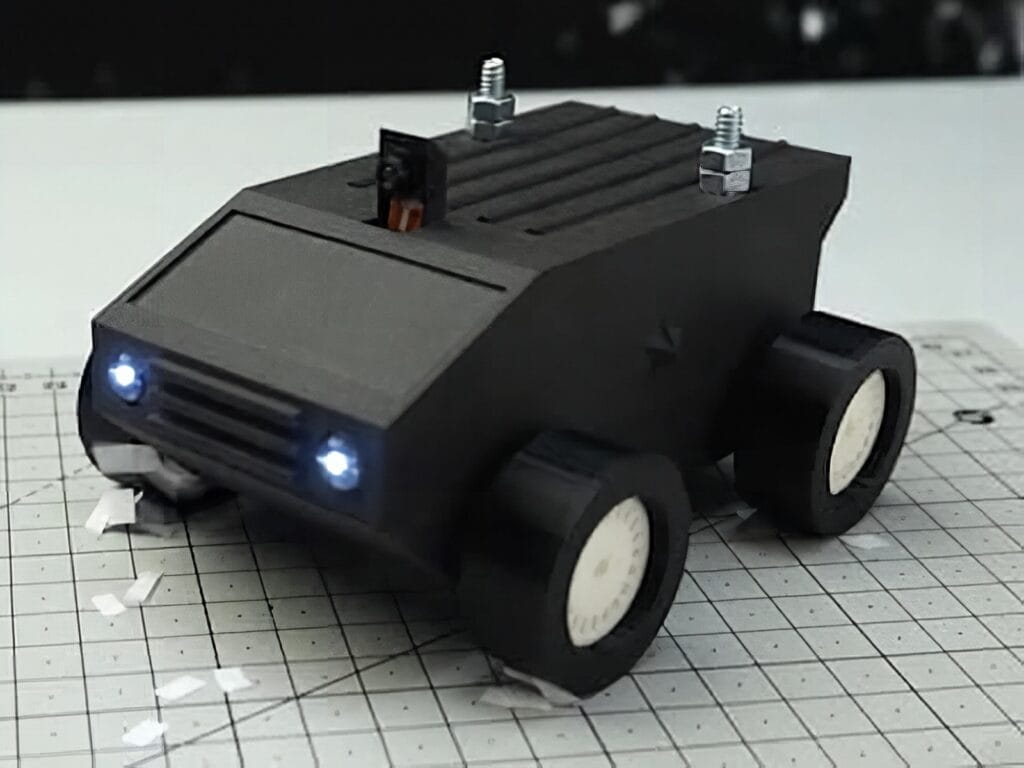
Ever wished you could shrink yourself down and ride shotgun in your RC car? A first-person view (FPV) build gets you pretty close — and you don’t need a deep wallet to make one happen.
YouTuber Simple Circuits recently put together a tiny four-wheel-drive racer that streams live video straight to your phone, all for around thirty bucks in parts. The whole thing fits in the palm of your hand, drives surprisingly well, and shows that capable robotics projects don’t have to break the bank. The footage from the onboard cam is smooth enough to actually steer with, which is the real test of any FPV rig.
What’s Under the Hood
The brain of the operation is the Seeed Studio XIAO ESP32-S3 Sense. This compact board is a great pick because it pairs an ESP32-S3 microcontroller with an integrated camera module on a single PCB — no separate camera shield required. It handles the live video stream and the motor control loop at the same time, keeping the wiring tidy.
Drive comes from four N20 micro gear motors paired with two DRV8838 motor driver chips, which gives the car proper 4WD traction and tight turning. A 3.7V LiPo cell powers everything, with a TP4056 charging module for safe recharges and a small boost converter to deliver a clean 5V rail. A decoupling capacitor smooths out the noise spikes when the motors kick on. The custom chassis is 3D printed in nylon, while the tires are printed in flexible TPU for grip.
On the software side, the ESP32-S3 is flashed using the Arduino IDE. Once it boots, the board spins up its own Wi-Fi hotspot — connect your phone, open the browser interface, and you’ve got live video plus directional controls in one window.
Build It Yourself
This kind of project is exactly why the maker community is so much fun right now. If you want to roll your own version, you can grab the Seeed XIAO ESP32-S3 Sense, motor drivers, LiPo cells, and TP4056 charging modules over at Circuitrocks. Prefer a different brain? An ESP32-CAM, Raspberry Pi Pico W with a separate camera, or even an Arduino Nano paired with an HC-SR04 ultrasonic sensor for obstacle avoidance would all make great variations on the theme. Print a chassis, solder it up, and you’ll be racing in an afternoon.
Frequently Asked Questions
Why use the Seeed XIAO ESP32-S3 Sense instead of an ESP32-CAM for an FPV RC car?
The XIAO ESP32-S3 Sense is much smaller than a typical ESP32-CAM module and has the camera, microcontroller, and PSRAM all on one tiny board, which makes it a better fit for a palm-sized chassis. You also get USB-C and built-in LiPo charging support, so wiring stays cleaner. An ESP32-CAM works too, but it’s bulkier and usually needs an external programmer.
Do I really need a boost converter and a TP4056, or can I just run the motors straight off the LiPo?
You can power the N20 motors straight from a 3.7 V LiPo, but the ESP32-S3 wants a clean 5 V rail and the camera draws current spikes that make brownouts likely under load. The TP4056 handles safe charging of the cell, and the boost converter gives the logic side a stable 5 V — together they prevent the board from rebooting every time the motors kick on.
What will I actually learn by building this project?
You’ll get hands-on practice with H-bridge motor control using the DRV8838 (PWM speed and direction), powering mixed-voltage systems with a TP4056 and boost converter, capturing and streaming MJPEG video over Wi-Fi from the ESP32-S3 camera, and serving a simple HTML/JS control UI from the board itself. Those four skills carry directly into bigger robotics, IoT, and embedded vision projects.
