
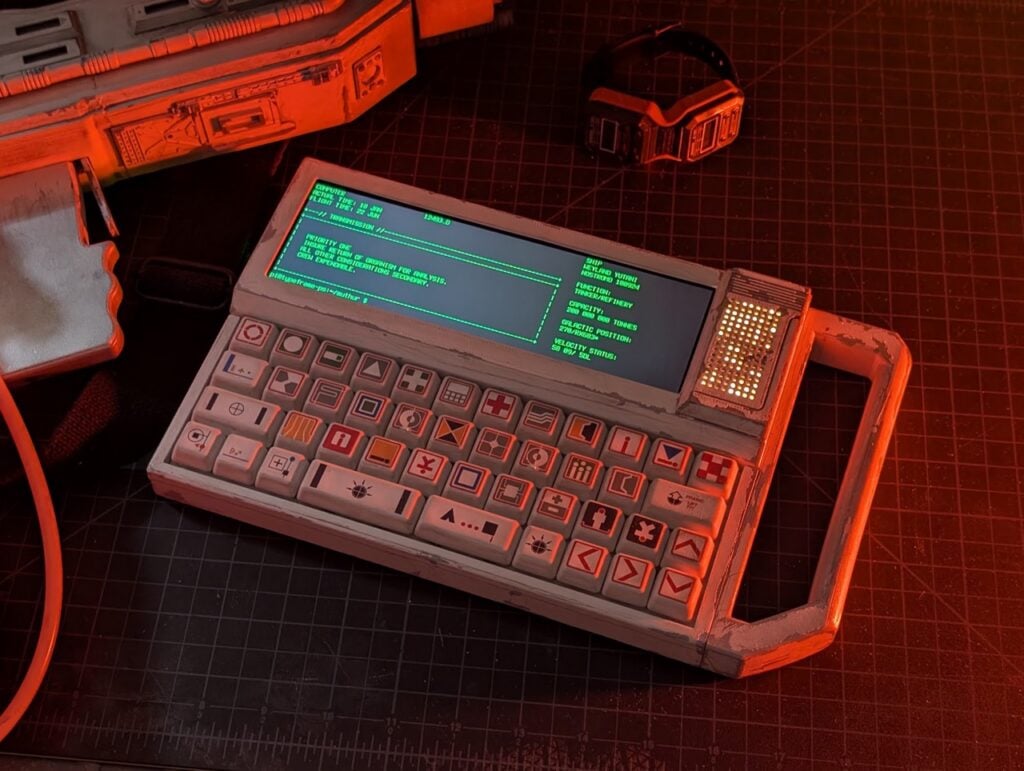
If you grew up watching Ripley dodge xenomorphs aboard the Nostromo, you already understand why this little build is so satisfying. Maker Jeff Merrick has crafted a slate-style handheld cyberdeck dripping with Alien franchise vibes — and the brain inside it is a humble Raspberry Pi Zero 2 W.
From scrapped writerdeck to retro-future handheld
The project, dubbed the Typeframe PS-85, started life as a different idea entirely. Jeff originally tried to convert a Penkesu-style retro PC into a writerdeck, but the cramped 40 percent keyboard and the limits of the original Pi Zero pushed him to rethink the whole thing. He pivoted, repurposed the internals he had already wired up, and chose a slate form factor on purpose: no hinges, no drama, just a clean handheld slab that boots fast and feels surprisingly sturdy.
The visual style is where this thing really shines. Jeff already had a set of keycaps printed with the Semiotic Standard glyphs Ron Cobb designed for the original Alien films, and he used those as the design anchor. He weathered the 3D-printed case with a paint-and-mask technique borrowed from his prop-making hobby — silver base, masked highlights, white topcoat, then chipped back to look like a piece of gear pulled out of a starship locker after a rough decade.
What’s inside the case
Under the hood, the build pairs a Raspberry Pi Zero 2 W with a Waveshare 7.9-inch touchscreen and a custom mechanical keyboard. The exposed GPIO header is put to clever use too: a removable LED panel built around an Adafruit CharliePlex LED Matrix Bonnet plugs into the corner, doubling as a nod to the Mother AI computer from the films. Wiring is routed for easy external access, which makes future tinkering a lot less painful.
Build it yourself
The great news is that nothing here is exotic — this is a project you can absolutely take on at home. A typical parts list would include:
- A Raspberry Pi Zero 2 W (or even a Pi 4 if you want more headroom)
- A small touchscreen display
- A hot-swap mechanical keyboard PCB and a set of themed keycaps
- A LiPo battery and charge/boost board
- A 3D-printed enclosure of your own design
- A LED matrix or OLED for that extra sci-fi flair
You can grab Raspberry Pi boards, ESP32 modules, sensors, displays, and pretty much every passive part a build like this needs over at Circuitrocks. Whether you go full Alien, lean cyberpunk, or invent your own universe, a portable Pi build is one of the most rewarding weekend projects in the maker world right now.
Frequently Asked Questions
Why use a Raspberry Pi Zero 2 W in this cyberdeck instead of a full-size Pi 4 or Pi 5?
The Pi Zero 2 W gives you a quad-core ARM Cortex-A53 and onboard Wi-Fi/Bluetooth in a footprint roughly the size of a stick of gum, which is what makes a slate-style handheld even possible. A Pi 4 or 5 would push the case thickness, draw more power from the battery, and run hotter against the 3D-printed shell. For a writerdeck/light-Linux handheld, the Zero 2 W is the sweet spot.
What does the Adafruit CharliePlex LED Matrix Bonnet add over a NeoPixel matrix?
The CharliePlex Bonnet drives a 16×9 grid of individually dimmable LEDs over I2C using only a couple of GPIO pins, which keeps the rest of the Pi’s GPIO header free for the keyboard and screen. Compared to NeoPixels it has way lower power draw and a softer, more uniform glow — perfect for the retro Mother-AI aesthetic the project is going for.
What will I actually learn from building a cyberdeck like this?
You’ll get hands-on practice with Raspberry Pi GPIO and I2C peripherals, designing for a 3D-printed enclosure (heat, ventilation, port cutouts), driving an alternative display over DSI/HDMI, and integrating a custom mechanical keyboard with USB HID. On the software side you’ll touch boot configuration, kiosk-mode launchers, and lightweight Linux tuning — all transferable to handhelds, kiosks, and embedded Linux gadgets.
