
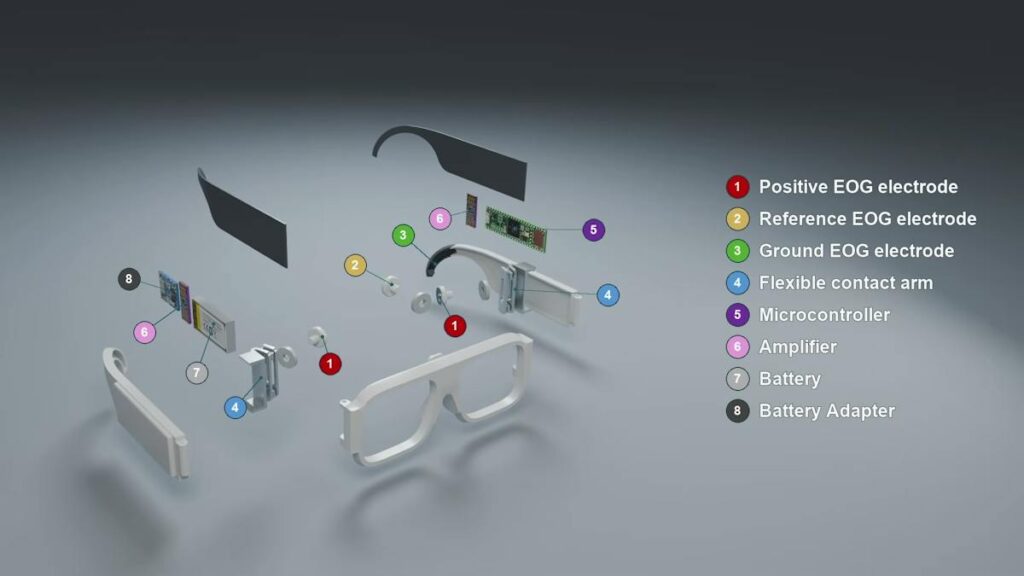
Eyewear makers are turning glasses frames into input devices. JINS MEME already ships frames with electrooculography (EOG) electrodes in the nose pads, and every smart-glasses demo still trips over one question: how do you issue a command without talking to yourself or waving at the air? A team from Carnegie Mellon, Tsinghua and Wuhan University has an answer that fits this trend. Their prototype, VergeIO, senses where your eyes are focused in depth and turns a shift from near to far into a button press.
The build itself
VergeIO rides on vergence: your eyes rotate inward to focus on something 30 cm away and outward when you look across the room. The two eyes move in opposite directions, so a single-channel EOG layout cancels the signal out. The team fixed this with four electrodes: one dry electrode on each temple, a shared reference on the bridge of the nose, and a ground behind the ear. Two amplifier modules feed a Teensy 4.1, which filters the signal and runs a random-forest classifier on the fly. The headset weighs 75 g and cost about US$140 in off-the-shelf parts; the authors estimate a tuned version at US$73. The analog front end draws 3 mW, so a 570 mAh cell could run it for roughly eight days.
In a 20-person study with targets at 30, 70 and 200 cm, the system hit 97% accuracy on four depth gestures with no per-user calibration, across 1,520 gesture samples. With all six gestures enabled, accuracy drops to about 77%. An eyebrow raise arms the system, which cut accidental triggers to near zero. The paper is at https://arxiv.org/abs/2507.02187, and Hackster’s write-up has photos.
The technical takeaway
Three ideas here transfer to any biosignal project. Electrode placement is the design: splitting the two eyes into independent channels is what made vergence visible at all. Dry electrodes are tricky, so the prototype uses flexible contact arms to keep pressure on the skin; a pad that lifts for a moment produces a spike larger than the signal you want. Filter before the ADC pin: EOG lives in the microvolt-to-millivolt range, so use an instrumentation amplifier with a gain near 1000 and a low-pass filter well under 50 Hz to keep mains hum out of your classifier. The Teensy 4.1’s 600 MHz Cortex-M7 has plenty of headroom for a small random forest, so it runs in real time without a laptop.
What to try next
An AD8232 breakout, sold as an ECG module, is an instrumentation-amp front end that reads EOG once you move the electrodes to the temples. Wire its output to an analog pin on an ESP32 or Arduino, sample at 250 Hz, and plot blinks and left-right eye movements on the serial plotter first. Once those traces are clean, try the near-far shift with a second channel. For an ECE thesis group this is a full capstone: analog front end, signal processing, a classifier, and a user study. Start with the electrode diagram in the arXiv paper and one AD8232 kit, and log at least 50 gestures per person before you trust any accuracy figure.
Frequently Asked Questions
How does VergeIO know where my eyes are focused?
It measures vergence, the inward and outward rotation of your eyes as focus shifts between near and far objects, using electrooculography. Four dry electrodes (two temples, nose bridge, behind the ear) pick up the voltage changes, and a Teensy 4.1 filters the signal and classifies the gesture with a random forest.
What does the prototype cost and how long does it run?
The research prototype weighs 75 g and was built from off-the-shelf parts for about US$140; the authors estimate an optimized version at around US$73. The analog sensing front end draws only 3 mW, so a 570 mAh battery could support roughly eight days of continuous sensing.
What will I learn if I build an EOG project like this?
You will practise analog instrumentation (electrode placement, amplifier gain, filtering out 50 Hz mains hum), sampling biosignals on a microcontroller ADC, extracting features from a time series, and training a small classifier. It also teaches how to run a proper user study and report accuracy honestly, which is exactly what a capstone panel looks for.
