
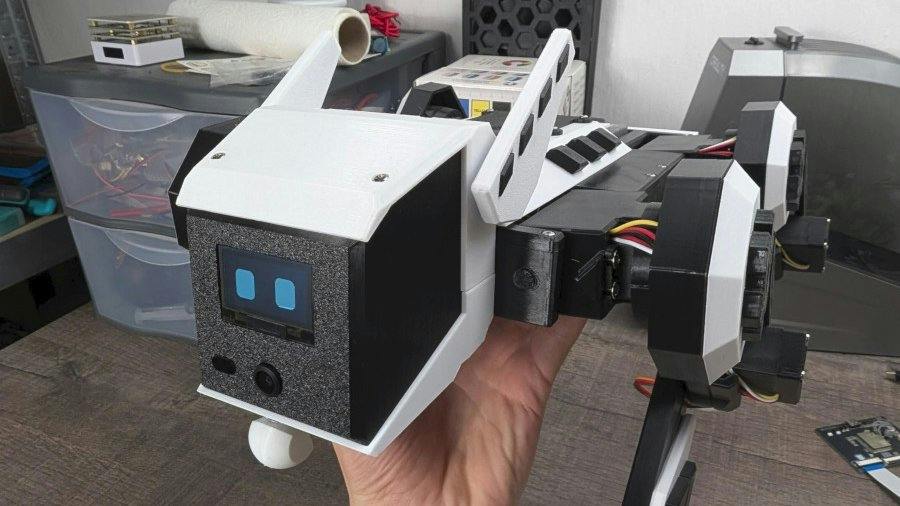
Most beginner robots fall into two camps: a four-wheeled toy that cannot do much, or a legged robot so tangled in jumper wires that half your weekend goes to hunting one loose pin. Paul Loisil, a computer science student, built the TNY-360 to sit between those two, and the second version is now open for pre-order.
What the TNY-360 v2 is
It is a quadruped robot dog driven by an ESP32-S3. Instead of one big board, the electronics are split into separate PCBs for control, sensing, power, and the main brain. They connect through JST cables and low-profile pin headers, so a connector only fits one way and a miswire is hard to make. A dorsal port exposes I2C and power, so you can design your own add-on board and bolt it on top.
The base robot carries 12 modified TowerPro MG996R servos for the legs and two MG90D micro-servos that wiggle the ears. Sensing comes from an OV2640 camera, a VL53L0X time-of-flight distance sensor, an LSM6DS3 six-axis IMU, and an I2S MEMS microphone. A 128×64 SSD1306 OLED and a small speaker handle local feedback.
The two-core trick
The firmware assigns one ESP32-S3 core to each job. A core called Reflex runs kinematics and a closed-loop 200 Hz control loop. The other, called Brain, handles networking, orchestration, and the user interface. Keeping them apart means a slow Wi-Fi call cannot make a leg stutter.
The closed loop depends on a hardware gotcha fix: stock MG996R servos give no position feedback, so Loisil added a custom op-amp buffer PCB that taps an analog feedback signal. The firmware also includes a calibration and self-diagnostic routine that tells you what you wired wrong and how to fix it.
Build it yourself
- Pre-orders on the TNY Robotics site start at $332 for a barebones kit and $458 for the maker kit. A $688 assembled version is planned.
- V1 files are on GitHub under a CC BY-NC-SA 4.0 license, with V2 files promised soon. Clone V1 first and read how the 200 Hz loop is structured.
- No budget for a kit? Pin one ESP32 task to each core with FreeRTOS and log how often a 5 ms loop misses its deadline.
Read the original coverage on Hackster.io, then browse ESP32 boards and servos at circuit.rocks for a school robotics build.
Frequently Asked Questions
How does the TNY-360 keep its legs stable?
One ESP32-S3 core runs kinematics and a 200 Hz closed-loop servo controller, using analog feedback from MG996R servos modified with a custom op-amp buffer PCB.
What parts and cost does the TNY-360 v2 need?
The base robot uses 12 MG996R servos, two MG90D ear servos, an OV2640 camera, a VL53L0X distance sensor, an LSM6DS3 IMU, an OLED, and a microphone. Kits start at $332.
What will I learn if I build this?
You learn inverse kinematics, closed-loop servo control, dual-core ESP32 task design, and I2C sensor wiring. These skills suit robotics competitions and capstone projects.
