
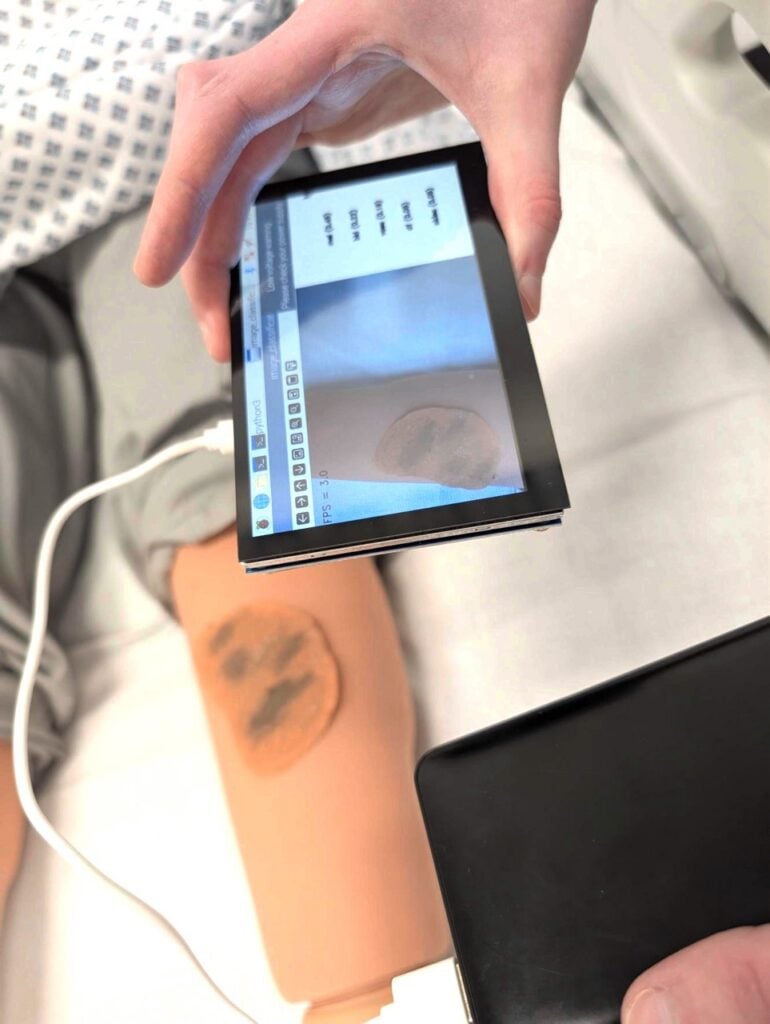
Tess Watt kept circling the same problem at Heriot-Watt University in Edinburgh: the patients most likely to miss an early melanoma are the ones living furthest from a dermatologist. Her answer was not a cloud API or a phone app. It was a Raspberry Pi 3 Model B with a camera attached, sitting on a bench in the university’s health technologies suite, classifying a photo of a mole without touching the internet once.
What she built
LesionIQ is an early-detection tool for skin lesions. A patient photographs the affected patch through a deliberately plain interface, and the Pi compares that image against thousands of labelled lesion photos stored locally on the SD card. No upload, no account, no signal bars required. The result goes to a GP rather than straight to the patient, because UK law requires a clinician to validate any diagnosis the model produces. Watt reports 85% accuracy so far, is candid that the ceiling is dataset diversity rather than silicon, and is still working through ethical approval with NHS Scotland. This is a research demonstrator, not something you point at your own arm.
How it runs on 1GB of RAM
This is TinyML territory: inference on a board with a 1.2GHz quad-core Cortex-A53 and 1GB of RAM, no accelerator, no GPU. The camera hangs off the CSI ribbon connector, and both the classifier and its reference dataset live on-device. Watt picked the Pi over a smartphone deliberately. Phones are expensive and scarce in exactly the rural and developing-world settings the device targets, and they assume connectivity that often is not there. A Pi 3 B plus a camera module runs roughly PHP 3,000 to 4,000 from local suppliers, which is the entire argument.
Why this belongs in your capstone folder
The interesting engineering here is not the model. It is the constraint: fit a useful classifier plus its comparison set onto a board you can run off a power bank in a barangay health station. If you are scoping a thesis, that framing travels well past dermatology, into leaf disease, water turbidity, or weld inspection. Read the full write-up at raspberrypi.com, then quantise a TensorFlow Lite model and time a single inference on whatever Pi is already on your desk. That number, not the accuracy figure, is what will shape your build.
Frequently Asked Questions
Why did LesionIQ use a Raspberry Pi 3 instead of a smartphone?
Tess Watt targeted rural and developing-world users, where phones are costly, less common, and often without reliable internet. A Raspberry Pi 3 Model B plus a camera module costs roughly PHP 3,000 to 4,000 and runs the classifier fully offline, so the whole dataset and model sit on the SD card instead of a server.
How accurate is the classifier, and can it replace a doctor?
It sits at about 85% accuracy and is still a research demonstrator, not a clinical product. UK law requires a medical professional to validate any diagnosis it outputs, and the team is working through ethical approval with NHS Scotland. Watt names dataset diversity, not processing power, as the main limit on accuracy.
What will I learn if I build something like this?
You will practise the skills that carry a capstone: quantising a TensorFlow Lite model so it fits in 1GB of RAM, wiring a camera over the CSI ribbon connector, measuring real inference time on constrained hardware, and designing an interface someone can use without training. The same offline-inference pattern transfers to leaf disease detection, water turbidity checks, or weld inspection.
