
A spare Saturday, a soldering iron, and about ₱1,200 of parts is enough to put a control link on your bench that stays locked at ranges most pilots never bother testing. ExpressLRS is open source top to bottom, and the reason it reaches so far has almost nothing to do with brute-force power. The transmitters top out near 1 watt.
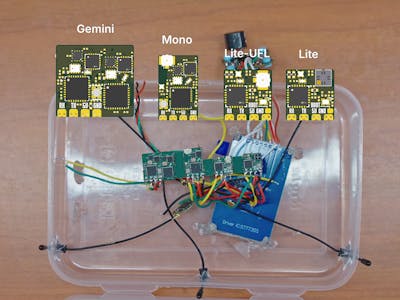
Stan Coene of the OpenDrone channel spun four open-source ELRS receiver variants to show where the real design decisions live. Two are 2.4 GHz boards that differ only in antenna: one with a U.FL connector for an external whip, one with a surface-mount ceramic chip antenna sitting flat on the PCB. A third drops to 900 MHz, where the longer wavelength pushes through trees and concrete better. The fourth runs two complete radio chains at once for diversity reception.
What is actually on the board
Less than you would expect. An ESP32 handles the CRSF conversation with the flight controller. The radio work goes to a Semtech LoRa transceiver: SX1280 on 2.4 GHz, SX127x on 900 MHz. Round that out with a 3.3 V regulator, a status LED, a boot button for flashing, and the antenna connector. That is the whole bill of materials.
Where it gets tricky
At 2.4 GHz a copper trace stops behaving like a wire and starts behaving like a transmission line. Miss the 50-ohm target (wrong trace width, a sloppy connector footprint, a gap in the ground plane) and part of your transmit energy reflects back into the chip instead of leaving the antenna. Coene deliberately broke one of the standard RF rules and routed his antenna signal through a via, then ringed it with ground-stitching vias so the return current kept a continuous path between layers. Measured penalty: essentially none.
The range itself comes from LoRa’s Chirp Spread Spectrum. Instead of hopping between two frequencies the way FSK does, each symbol is a frequency sweep. The receiver multiplies the incoming chirp against an internally generated inverse chirp and runs an FFT, which collapses the wanted signal into one narrow bin while the noise stays smeared across the band. That processing gain is why a 1-watt transmitter is still readable below the noise floor.
Spend your Sunday on it
You do not need to fab a PCB to start. Grab any off-the-shelf ELRS receiver, flash it with the ExpressLRS Configurator, bind it to your handset, and watch the link-quality and RSSI stats while you walk it down the street. Then read through Coene’s layout breakdown and try the ceramic-antenna version — it is the cheapest way to find out whether your ground plane is doing its job.
Frequently Asked Questions
What chips are inside an ExpressLRS receiver?
An ESP32 handles the CRSF link to the flight controller, and a Semtech LoRa transceiver does the radio work: the SX1280 on 2.4 GHz or an SX127x on 900 MHz. The rest is a 3.3 V regulator, a status LED, a boot button, and either a U.FL connector or a ceramic chip antenna.
Do I need to design my own PCB to run ExpressLRS?
No. Off-the-shelf ELRS receivers cost roughly a few hundred pesos and flash from the ExpressLRS Configurator over USB or WiFi. Rolling your own board is only worth it if you want to experiment with antenna placement or dual-radio diversity.
What will I learn if I build this?
Practical RF layout: why a 2.4 GHz trace has to hold 50 ohms, how ground-stitching vias keep return current continuous between PCB layers, and what an impedance discontinuity costs you in reflected power. You also pick up how Chirp Spread Spectrum and FFT correlation pull a signal out from under the noise floor, plus hands-on ESP32 firmware flashing and antenna testing.
