
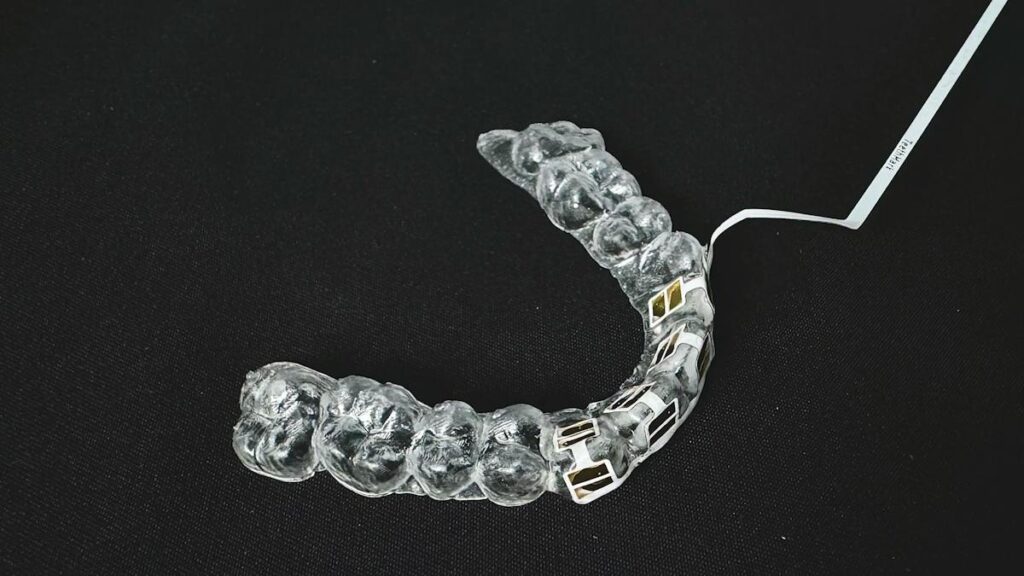
Hands-free control usually means voice, and voice fails in a noisy lab or a quiet library. The tongue has neither problem: it is fast, it finds a single tooth without looking, and nobody hears it. That is why a team at Aarhus University built TeethMark, a clear dental retainer with an ESP32 inside that turns your four upper front teeth into a touchpad that can also tap you back.
What TeethMark does
The retainer carries a flexible PCB with gold-plated electrodes sitting on the inner and outer faces of the upper incisors. Touch a tooth with your tongue and capacitive sensing registers it. The firmware recognises three gesture types: a tap on one tooth, a slide across several, and a chord where the tongue touches more than one tooth at once. Feedback runs the other way through the same electrodes. Short electrical pulses on the inner faces are felt by the tongue, while pulses on the outer faces tickle the inside of the lip, so a notification can arrive without any tongue movement at all. In a 12-person study, tap recognition hit 82.92%, multi-tooth touch 92.78%, slide 94.92%, and users identified the direction of a feedback pattern 99.17% of the time. One demo steered a UV curing lamp by tongue while both hands held the workpiece.
The electronics inside
An ESP32 handles both jobs. Sensing uses a standard capacitive-touch library, so every electrode is a touch pad hanging off a GPIO. Stimulation is the interesting part. A MOSFET driver stage generates the pulses at roughly 5 to 7 V for the tongue side and 16 to 18 V for the lip side, with the circuit capping current at 10 mA. Because the same electrodes sense and stimulate, a relay switches the pads between the two circuits so the high-voltage pulses never land on the touch inputs. The four-layer flex PCB includes a shield layer to keep the sensing stable inside a wet, moving mouth. Each electrode is a 4 x 2 mm pad, two per tooth face, placed on a scan of the wearer’s teeth before the brace is formed.
Try the safe half yourself
Do not put homemade electrodes in your mouth; the stimulation side needs medically rated isolation that a hobby board does not give you. The sensing half is a fine experiment for an ECE student. Breadboard an ESP32 dev board, solder four copper pads or coins to short leads, and read them with touchRead() on the touch-capable pins (GPIO4, 12, 13, 14, 15, 27, 32, 33 on the classic ESP32). A finger on the pad drops the reading from around 70 to under 20, and the gotcha is that the baseline drifts with humidity, so recalibrate on boot. Map tap, slide and chord gestures in code and you have the input layer. The UIST 2026 paper is at doi.org/10.1145/3830398.3830646, and the Hackster write-up is here. An ESP32 dev board at circuit.rocks runs under 400 pesos, which is all the sensing demo needs.
Frequently Asked Questions
How does TeethMark detect tongue gestures?
Gold-plated electrodes on a flexible PCB sit on the upper front teeth and act as capacitive touch pads read by an ESP32. The firmware classifies a tap on one tooth, a slide across several, and a simultaneous touch on multiple teeth. In a 12-person study, recognition reached 82.92% for taps, 92.78% for multi-tooth touches and 94.92% for slides.
How does it give feedback without a motor?
The same electrodes deliver short electrical pulses through a MOSFET driver, about 5 to 7 V on the tongue side and 16 to 18 V on the lip side, with current capped at 10 mA. A relay switches each pad between the sensing circuit and the stimulation circuit so the two never interfere.
What will I learn if I build the sensing part of this?
You will learn how ESP32 capacitive touch pins work, how to calibrate noisy analog baselines, how to turn raw touch readings into tap, slide and chord gestures in code, and why sensing and high-voltage stimulation must be isolated from each other. It is a strong starting point for an assistive-technology thesis.
