
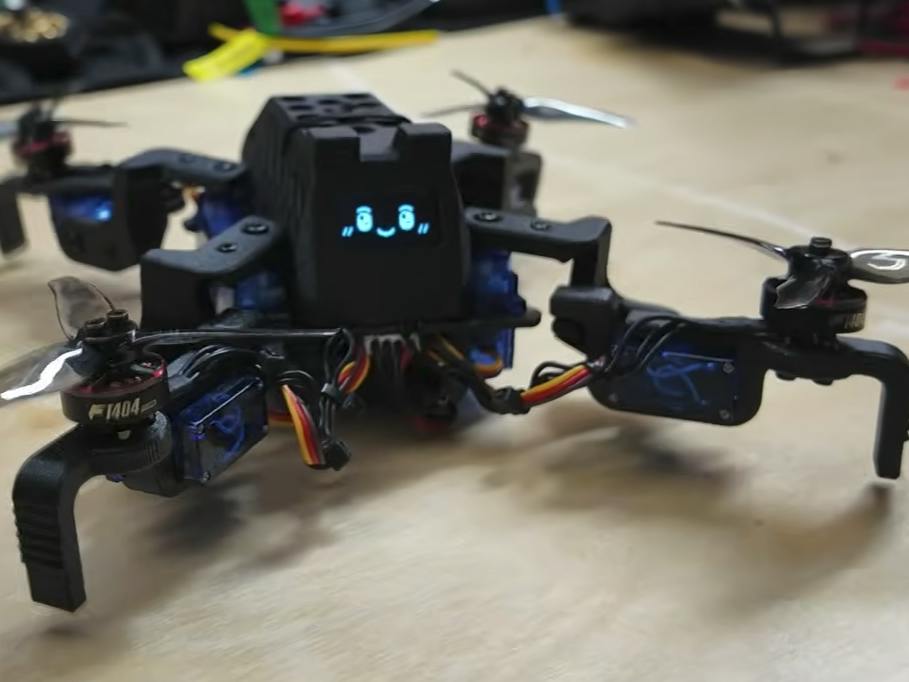
Weight is the budget that decides everything in a small robot, and a 264-gram walker that also flies shows what that means in grams. Maker Dorian Todd took his open source Sesame quadruped, designed to be built for under $60, and bolted on drone motors. Hackster has the write-up.
What Todd built
Sesame walks on eight servo joints and shows facial expressions. Todd wanted it to unfold its legs, lift off like a quadcopter, then land and walk again. The first target was about 250 g, the territory of “toothpick” drones. The finished robot came in at 264 g and completed the full walk, extend, take off, hover and land sequence outdoors after several crashes in the garage.
How the weight came down
- He swapped the eight MG90S metal-gear servos for SG90 plastic-gear servos, which saved roughly 35 g.
- The frame got weight-saving cutouts and was printed in carbon fiber-reinforced nylon (PPA-CF), with extra carbon parts cut on a desktop CNC.
- Mechanical stops lock each leg at 90 degrees when extended, so the propellers pull the legs against the stops instead of straining the servos.
The electronics are split into two independent systems. A LOLIN S2 Mini (ESP32-S2) handles walking and the face, and a separate all-in-one flight controller handles motors, stabilization and radio. If the flight side misbehaves, the robot can still walk, and the two codebases never fight over the same timing loop.
Build it yourself
You do not need the flying part to learn from this. Start with the walking build: eight hobby servos on a 5 V supply, with the servo power kept off the ESP32‘s 3.3 V rail, because a stalled servo can brown out the board. Power the servos from their own regulator and share only ground. A school robotics team can build the walker first, then try a weight audit, weighing every part on a kitchen scale and logging grams per subsystem. Check the original Sesame files on the project page linked above, and look for SG90 servos and ESP32 boards at circuit.rocks.
Frequently Asked Questions
What controls Sesame when it walks and when it flies?
A LOLIN S2 Mini ESP32 board handles walking and facial expressions, while a separate all-in-one flight controller manages the drone motors, stabilization and radio.
How did the builder cut weight to 264 g?
He replaced eight MG90S metal-gear servos with lighter SG90 plastic ones, saving about 35 g, and used cutouts and carbon fiber-reinforced nylon for the frame.
What will I learn if I build this?
You practice servo control, power budgeting and weight management, plus splitting a robot into independent controllers so one failure does not stop the other. These skills suit robotics competitions and capstone projects.
