
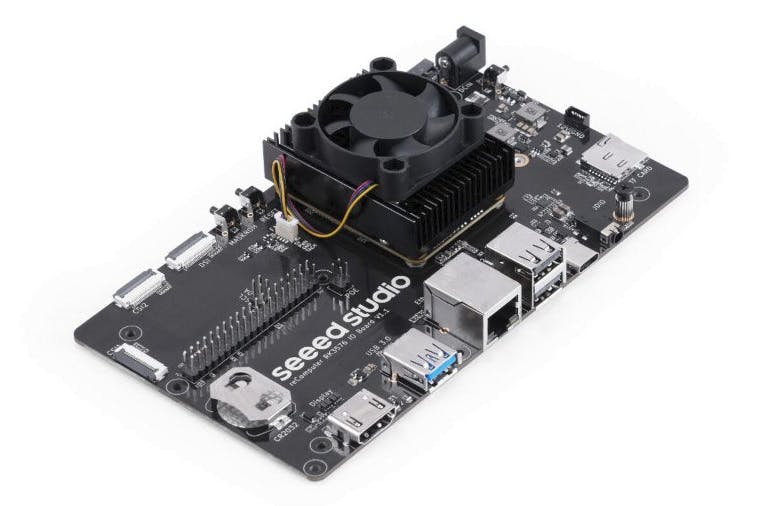
Vision projects on campus usually stall in the same spot. Your detection model runs fine on a laptop, then drops to four or five frames per second on the borrowed single-board computer, and the defense panel watches a slideshow instead of a demo. Seeed Studio’s reComputer RK3576 Module Dev Kit is built for exactly that gap: the neural coprocessor is already on the module, so you are not bolting an accelerator onto a board that was never designed for one.
What Seeed actually shipped
The kit is a compute-on-module paired with a carrier board, which means you can prototype a camera pipeline before committing to a custom PCB. Seeed’s pitch is that you move from a bare module to a working platform without designing your own carrier first, and for a thesis timeline that ordering matters more than raw specs. The carrier carries a 40-pin GPIO header that follows the Raspberry Pi HAT standard, so sensor boards and driver HATs you already own will seat on it.
The silicon, in numbers
- Rockchip RK3576: four Cortex-A72 cores to 2.2GHz plus four Cortex-A53 cores to 2GHz, with a Mali G52-MC3 GPU.
- On-module NPU rated at 6 TOPS, enough for YOLO11 at close to 80 FPS on a 640×640 input.
- Optional RK1820 accelerator module adds 20 TOPS and 2.5GB of dedicated RAM.
- MIPI CSI and DSI, HDMI, USB-C DisplayPort Alt Mode, gigabit Ethernet with PoE, Wi-Fi 6 and Bluetooth 5.4.
One gotcha worth flagging before you budget: the M.2 M-key 2280 slot is shared. Populate it with the RK1820 accelerator and you give up your NVMe drive, so a 20 TOPS build means logging your dataset to eMMC or over the network instead.
Build it yourself
Pre-orders are open at the Seeed Store at $219 for the 8GB RAM and 64GB eMMC bundle, or $379 with the accelerator, with shipping expected late October. That is real money for a student team, so scope the build first. Start on hardware you already have: run your YOLO11 weights on a Pi 5 or an ESP32-S3 camera board, measure the actual frame rate your application needs, and only then decide whether 6 TOPS closes the gap or whether you need the RK1820. Teams doing single-camera line inspection or a jeepney counter rarely need the bigger part. If you are moving from an existing Pi HAT rig, check your camera library supports the Rockchip MIPI CSI driver stack before you order, since that is where most ports lose a week. Full specs and Seeed’s own claims are in the Hackster writeup.
Frequently Asked Questions
How much AI performance does the reComputer RK3576 actually have?
The RK3576 module carries a 6 TOPS neural coprocessor, which Seeed says runs YOLO11 at close to 80 FPS on a 640×640 input. An optional RK1820 module adds another 20 TOPS and 2.5GB of dedicated RAM, but it occupies the M.2 M-key slot, so you lose NVMe storage on that build.
What does the kit cost and can I reuse my Raspberry Pi accessories?
Pre-orders are $219 for the 8GB RAM and 64GB eMMC bundle, or $379 with the RK1820 accelerator, shipping late October. The carrier board exposes a 40-pin GPIO header that follows the Raspberry Pi HAT standard, so existing HATs and sensor breakouts will physically seat, though camera drivers use the Rockchip MIPI CSI stack rather than the Pi’s.
What will I learn if I build a project on a kit like this?
You pick up edge AI deployment skills that a laptop project never teaches: quantizing a model to run on an NPU, measuring real frame rates against a camera feed instead of a benchmark, budgeting an M.2 slot between storage and compute, and reading a compute-module datasheet to plan a carrier board. Those are the skills that separate a working capstone demo from a slideshow.
