
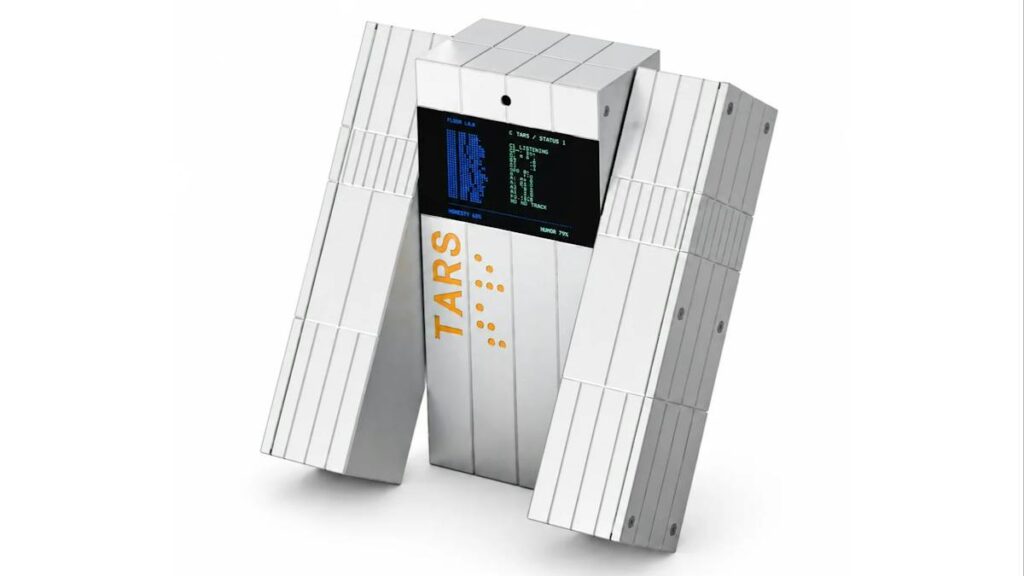
A robot that walks on three shuffling columns, cracks jokes at a humor level you pick, and fits beside your keyboard. RIG-TARS, from LuwuDynamics, borrows its slab silhouette from the TARS robot in Interstellar and shrinks it into a $99 open source kit built around an ESP32-S3. The film prop needed a team of puppeteers. This one needs a soldering iron, a free afternoon, and a Wi-Fi password.
What RIG-TARS actually is
Picture a desktop companion robot with a personality dial. The body is a stack of three articulated columns, each driven by a UART-controlled serial servo, so there are no wheels and no conventional legs. Moving the three columns in sequence lets the robot shuffle forward, step back, and turn. The result is the lurching gait from the film. A 2.4-inch, 320×240 colour TFT on the front works as a miniature command terminal, showing battery voltage, orientation, running tasks, and logs. The same screen exposes the personality settings, so you can set humor and sincerity levels before it starts talking.
A microphone and speaker handle voice wake-up and spoken commands, and the conversation itself runs through a cloud-hosted large language model. Programmable actions pair a reply with a physical move, so a sarcastic answer can arrive with a little lean or a quarter turn. A small camera and a six-axis IMU complete the sensor set.
Technical details
The ESP32-S3 at the centre is a dual-core 240 MHz part with 2.4 GHz Wi-Fi and Bluetooth LE, and it runs the motion control, the networking, and the voice loop at the same time. The IMU feeds accelerometer and gyro data back into the firmware so the robot can watch its own posture while the columns move, which matters when your legs are three stilts. The servos sit on a serial bus rather than one PWM line each, so three motors cost you a single TX/RX pair instead of three GPIO pins. Firmware is called RIG-Omni, released open source alongside the mechanical files and documentation, and it supports Model Context Protocol (MCP) tools so the robot can call outside services. One gotcha: the LLM features need a cloud API key and a stable connection, so budget for data alongside the hardware.
Build it yourself
The DIY kit is listed at $99 on the LuwuDynamics store, roughly PHP 5,800 before shipping and duties, and you print the body panels yourself from the released files. Expect to solder a few headers, seat the servos, mount the TFT, and flash RIG-Omni. For a robotics club or thesis team, the fun starts after assembly: write a new gait by changing the servo timing, feed the IMU into a balance routine, or add an MCP tool so the robot reads out your class schedule. Start with the Hackster write-up at hackster.io and grab the kit from shop.xgorobot.com. If you want to prototype the brain first, an ESP32-S3 dev board and a 2.4-inch 320×240 TFT from circuit.rocks will get the display terminal running before the servos arrive.
Frequently Asked Questions
How does RIG-TARS move without wheels or legs?
Three articulated columns, each on a UART-controlled serial servo, shift in sequence so the body shuffles forward, steps back, or turns. A six-axis IMU reports orientation so the RIG-Omni firmware can track posture mid-step.
What do I need to build the RIG-TARS kit, and what does it cost?
The DIY kit is $99 (about PHP 5,800) from the LuwuDynamics store. You print the body from the open files, assemble the ESP32-S3 board, servos, 2.4-inch TFT, microphone, speaker, and camera, then flash the open source firmware. Voice chat also needs a cloud LLM API key and Wi-Fi.
What will I learn if I build this?
Serial-bus servo control over UART, reading a six-axis IMU, driving a 320×240 TFT from an ESP32-S3, handling microphone and speaker audio for voice wake-up, and connecting a microcontroller to a cloud LLM through MCP tools. It is a compact introduction to embedded robotics plus edge-to-cloud AI, a strong combination for a capstone.
