
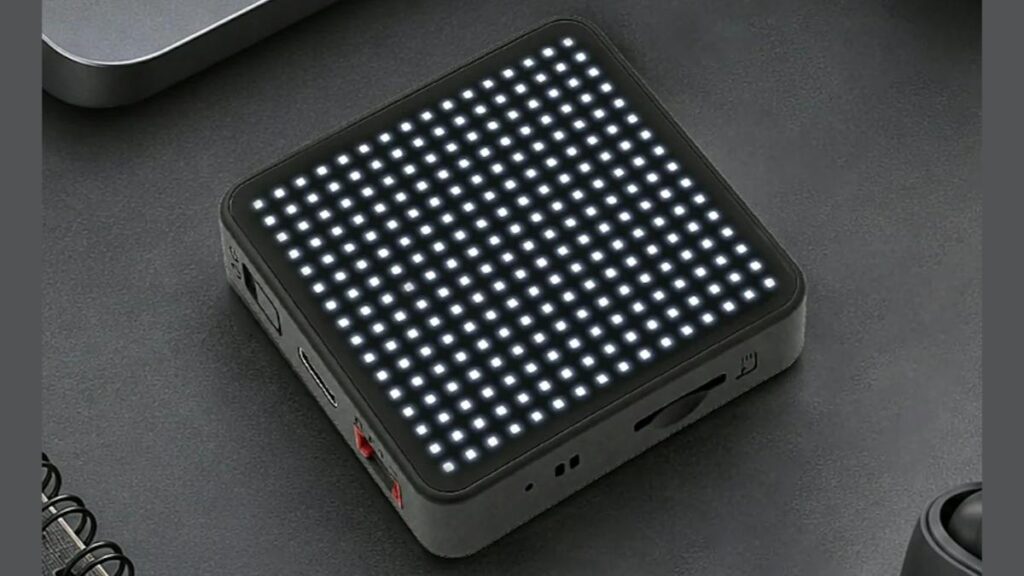
Need a status display that costs less power and wiring than a full-color LCD? M5Stack’s new Core Matrix answers with 256 white LEDs in a 16×16 grid, wrapped around an ESP32 board. Hackster covered the launch.
What is inside the Core Matrix?
The brain is an Espressif ESP32-C61HR8, a single-core 32-bit RISC-V chip at 160 MHz with 16 MB of flash and 8 MB of PSRAM. Radios cover 2.4 GHz Wi-Fi 6 and Bluetooth LE 5.0. A TM1680 driver handles the LED grid, so your code sends pixel data instead of scanning rows and columns by hand.
Around the matrix you get a Bosch BMI270 six-axis IMU, three programmable buttons, a power button, a passive buzzer and a microSD slot. USB-C handles power and flashing, and a battery connector lets you go portable.
What can a monochrome matrix actually do?
Icons, scrolling text, small animations and sensor bars all fit in 16×16 pixels. The IMU adds tilt and shake input, and its interrupt-based wake-up lets the board sleep until someone picks it up. That is a handy trick for battery projects.
- A Wi-Fi notification light that flashes an icon when an MQTT message arrives.
- A classroom noise meter: read a microphone module and draw a level bar.
- A tilt-controlled game of Snake for a hackathon booth.
How do I expand it?
The 30-pin M5-Bus header and the four-pin Grove port take external sensors. For an I2C module on Grove, the usual gotcha is address clashes, so scan the bus first and check that SDA and SCL are not shared with the IMU at the same address. Programming works through the Arduino IDE or M5Stack’s UIFlow2 visual tool.
Try it
Start in the Arduino IDE with the example sketch for the matrix, then swap the demo animation for a live reading from a DHT22 or BME280 on the Grove port. Sensor breakouts and ESP32 boards are stocked at circuit.rocks, and the full spec rundown is at the Hackster link above.
Frequently Asked Questions
Which chip powers the M5Stack Core Matrix?
An Espressif ESP32-C61HR8, a single-core RISC-V processor at 160 MHz with 16 MB flash, 8 MB PSRAM, Wi-Fi 6 and Bluetooth LE 5.0.
Can it run on battery?
Yes. It has an onboard battery connector and charging chips, and the BMI270 IMU supports interrupt-based wake-up so the board can sleep until it is moved.
What will I learn if I build this?
You practice driving an LED matrix, reading an IMU over I2C, wiring Grove sensors, and sending data over Wi-Fi. These skills carry into IoT thesis and robotics class projects.
