
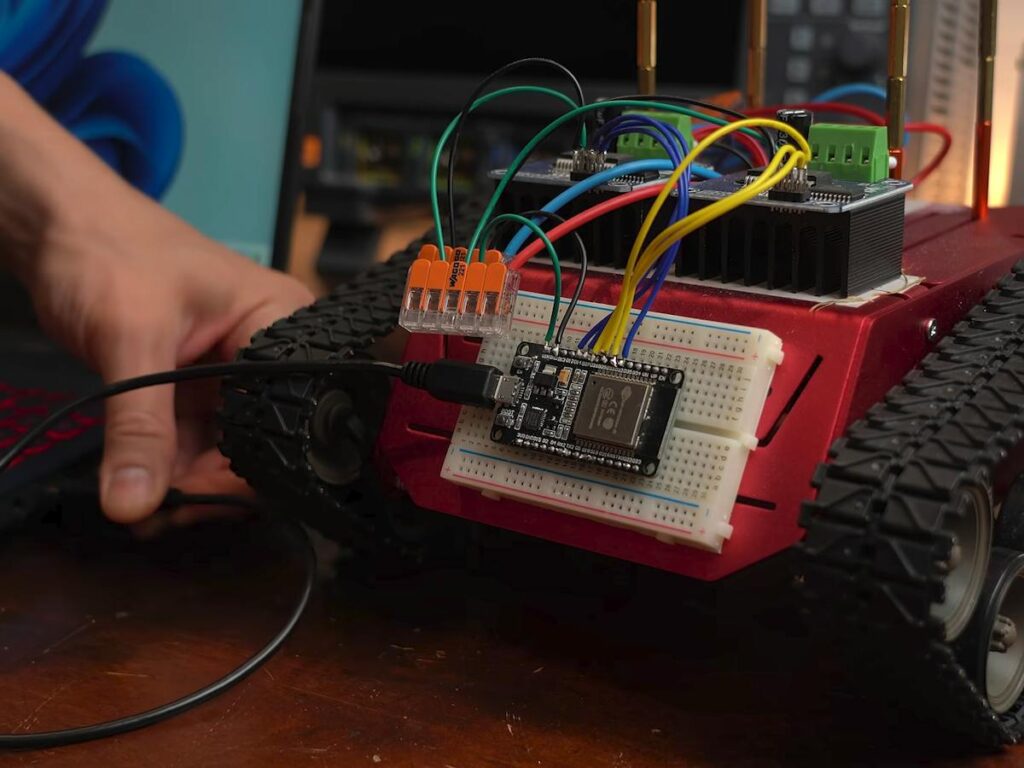
Edge AI is moving from lab demos to school robotics tables, and the question students keep asking is how much board they need. GreatScott answered it with a lawn mower, a $20 ESP32-S3 camera board, and a $200 Raspberry Pi 5 kit.
The build behind the comparison
His autonomous mower already navigates with RTK GPS, which is accurate to centimeters but expensive. A viewer suggested swapping it for a camera, so he tested whether a vision model could tell grass from gravel, stone, or a wooden walkway and steer the mower away from them.
He ran the same task on three platforms. The Seeed Studio XIAO ESP32S3 Sense is a dual-core chip at up to 240 MHz with 8 MB of PSRAM, an OV2640 camera, and a microSD slot. The Sipeed MaixCAM, around $80, runs Linux with 1 TOPS of neural acceleration. The Raspberry Pi 5 with the AI Kit adds a Hailo-8L rated at 13 TOPS plus a Camera Module 3.
The takeaway for your own robot
The Pi and Hailo pair wins on raw speed, running heavier models at 30 FPS or better. The surprise is that the mower never needed it. A grass-or-not decision fits in a small image classifier, quantized and converted to TensorFlow Lite Micro so it fits in the ESP32-S3‘s memory. Dataset size, input resolution, and task scope matter more than the TOPS figure on the box.
- Collect and label your own photos from the actual terrain or classroom floor
- Shrink the input image before training, then quantize to int8
- Only step up to a MaixCAM or Pi 5 when the small model misses cases you care about
What to try next
Start with a two-class problem your robot can see, such as line versus floor or open path versus wall. Train it with Edge Impulse or TensorFlow Lite, flash it to an ESP32-S3 camera board, and log the frames per second before buying anything bigger. Watch out for one gotcha: PSRAM must be enabled in your board settings or the model will not load. Student robotics teams can budget under PHP 1,500 for this first test. See the full write-up on Hackster, then browse ESP32 and Raspberry Pi boards at circuit.rocks.
Frequently Asked Questions
Can an ESP32-S3 really run computer vision?
Yes, for narrow tasks. The XIAO ESP32S3 Sense has a 240 MHz dual-core chip, 8 MB PSRAM and an OV2640 camera, and a quantized TensorFlow Lite Micro classifier can tell grass from other ground.
When is a Raspberry Pi 5 with the AI Kit worth the extra cost?
When you need larger models at 30 FPS or better. The Hailo-8L accelerator is rated at 13 TOPS, about $200 for the setup, versus roughly $20 for the ESP32-S3 board.
What will I learn if I build this?
You will practice labeling image datasets, training and quantizing small models, deploying to a microcontroller, and measuring frames per second against cost, a solid base for a robotics capstone.
