
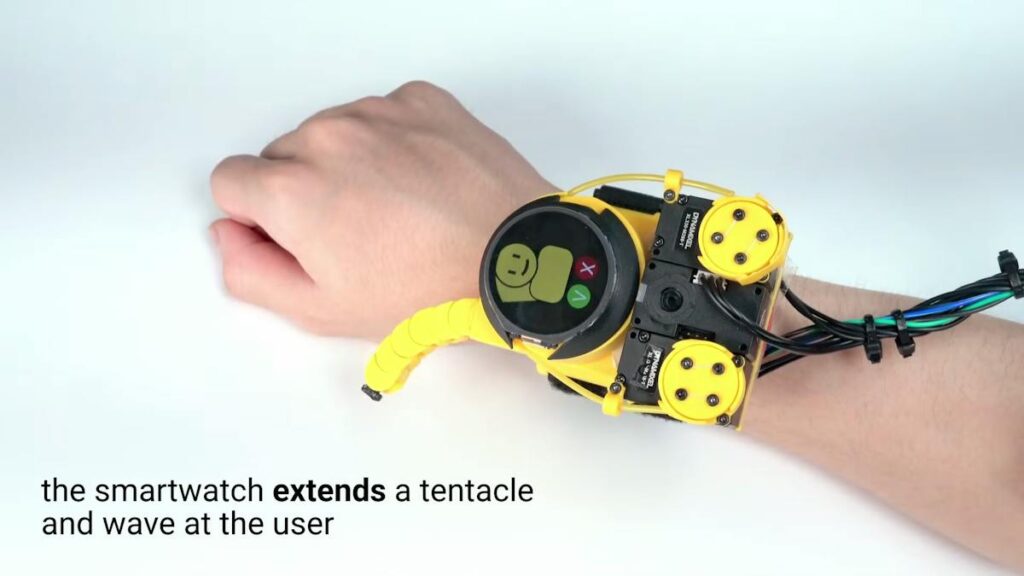
The tea has been steeping for exactly four minutes. Nobody reaches for the cup. Instead, a thin white arm unrolls from the underside of a wristwatch, hooks the string, and lifts the tea bag out on its own. That clip comes from a lab at National Taiwan University, where researcher P. Hsu and colleagues built a smartwatch with a retractable robotic tentacle and wrote it up in a paper titled “Augmenting Smartwatch with a Rollable Tentacle.” Hackster.io covered the prototype this month, and the demo video is the kind of thing that makes an ECE student stop scrolling.
What they built
From the top, the watch looks normal: a 1.28-inch round capacitive touchscreen on a LiPo-powered body. Under the display sits a circular housing where the tentacle coils up when idle. Trigger it and a motor pushes the arm out through a geared extrusion mechanism, reaching 90 mm in under a second. The arm can then bend left or right, hold a drink can like a spare finger, stick out like a progress bar while a timer counts down, nudge you toward a turn during navigation, or act as a joystick for a game of Pong, with the motors shoving it back and forth as haptic feedback. The team is upfront about the size: 50 mm across, 44 mm thick, 146.6 g on the wrist.
How they built it
The brain is an ESP32-S3, which handles motor coordination plus Wi-Fi and Bluetooth in a single module. Three Dynamixel XL330-M288T servos running in continuous-rotation mode do the physical work: one drives extension and retraction, the other two pull cables that bend the tentacle sideways. The XL330 line runs on 5 V, talks over a single half-duplex TTL line, and reports its own current draw, which is the trick that turns the arm into an input device. Poke or push the tentacle, the motor current rises, the firmware reads that spike, and the watch treats it as a gesture. The arm itself is a chain of rigid PLA segments joined by linkages, with a flexible TPU core threaded through the middle so it bends without buckling. Getting that stiffness balance right is the tricky part; too soft and the arm droops under a can of soda, too stiff and it refuses to coil back into the housing.
The takeaway for your own build
Strip away the tentacle and this is a familiar robotics stack: one microcontroller, a few smart servos on a shared bus, and current sensing used as a cheap force sensor. That last idea transfers straight into student projects. A gripper that stops squeezing when current spikes, or a desk robot that notices a tap on its arm, needs no extra sensor at all. If Dynamixels are out of budget (about US$24 each from Robotis before shipping), prototype the extend-and-bend motion with three SG90 micro servos and an ESP32 dev board, then read a current-sense resistor on an ADC pin to approximate the force detection. Read the full Hackster write-up at hackster.io and the XL330-M288T register map at emanual.robotis.com before you order parts.
Frequently Asked Questions
How does the tentacle watch sense when you push on the arm?
It reads motor current from the Dynamixel XL330 servos. Pushing the arm loads the motor, current rises, and firmware on the ESP32-S3 treats that spike as input. No separate force sensor is used.
What parts would I need to copy the basic mechanism?
An ESP32-S3 module, three XL330-M288T servos (about US$24 each), a 1.28-inch round touchscreen, a small LiPo cell, and a chain of rigid PLA segments with a flexible TPU core. A budget version swaps the Dynamixels for SG90 micro servos and an ESP32 dev board.
What will I learn if I build this?
Driving several smart servos over one half-duplex TTL bus, using current draw as a stand-in for a force sensor, designing a cable-driven bending mechanism, and packing motors, battery and radio into a wearable. Solid capstone material for mechatronics or human-computer interaction tracks.
