
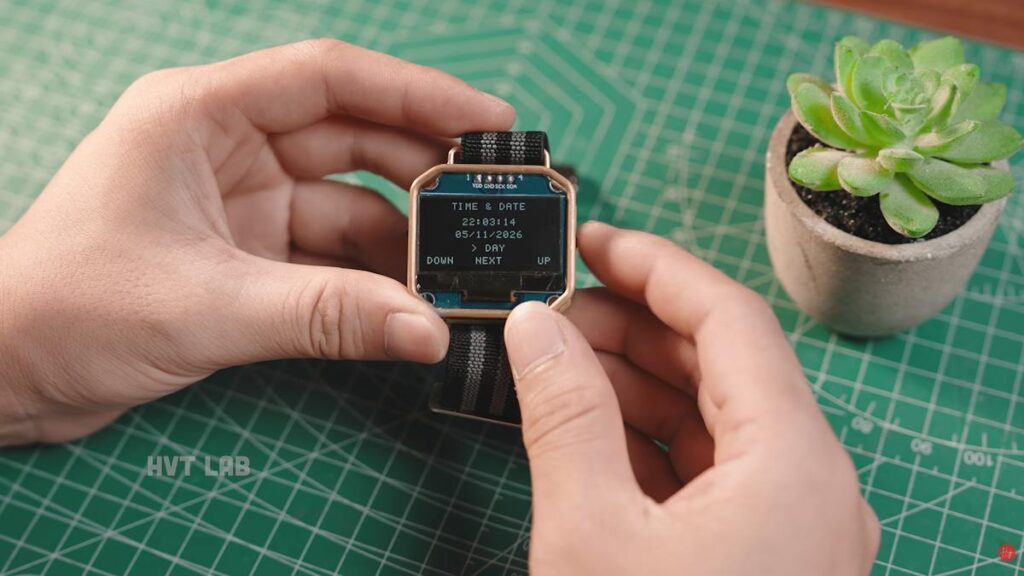
Can you build a working smartwatch without a PCB, a 3D printer or a custom case? Huy Vector of the HVT Lab channel did it with an ESP32-C3 Super Mini, a 1.3-inch OLED, a DS3231 clock module and a frame bent from 2 mm brass tubing, for under $10 in parts, roughly PHP 600.
What the brass watch actually is
The frame is the case. Two loops of 2 mm brass tube are bent to the outline of the display, joined by 1.5 mm link tubes and soldered into a rigid skeleton that holds every module by its edges. The OLED board had its corners trimmed to fit, and its pin header was swapped for stubs of 1 mm brass wire soldered straight to the frame. Behind the screen sit the ESP32-C3 Super Mini (22.5 x 18 mm, 160 MHz RISC-V core, 4 MB flash, Bluetooth 5), a DS3231 real-time clock that keeps time while the main board sleeps, a 3.7 V lithium cell with a tiny USB-C charger board, a slide switch for power and a three-way toggle for menu navigation. A 20 mm strap and a brush-on water-resistant coating finish it. Sweat and rain are fine; swimming is not. The firmware is NWatch C3, a port of Zak Kemble’s open-source N|Watch from 2013, and it syncs time from a phone over Bluetooth, shows app notifications and flags incoming calls. The full write-up is at Hackster and the build video is at youtu.be/QQfxIBTZZJk.
How does the wiring stay so clean?
Two tricks. First, the OLED and the DS3231 share one I2C bus, so the whole watch needs just SDA, SCL, 3.3 V and ground between the three boards. The two chips live at different addresses (0x3C for the display, 0x68 for the clock), and the modules carry their own pull-up resistors, so no extra parts are needed. On the C3 Super Mini the Arduino core defaults to GPIO8 for SDA and GPIO9 for SCL; if your screen stays black, check those two pins before anything else. Second, Vector soldered every ground connection to the brass frame itself. The skeleton becomes the ground rail. The gotcha: anything that touches the frame is at 0 V, so the battery positive lead, the charger output and the switch contacts need heat-shrink or they will short the moment the watch flexes. The firmware flashes from Chrome or Edge over USB, so no toolchain install is required to get a first boot.
Try it
Start on a breadboard: ESP32-C3 Super Mini, 1.3-inch I2C OLED and DS3231, all available at circuit.rocks, then flash NWatch C3 and get the clock face running before you pick up a torch. Bend the frame last, and measure your display board first, because 1.3-inch modules from different sellers vary by a millimetre or two. Materials list, wiring diagram and firmware download are on the project page at huyvector.org. If your OLED is the 0.96-inch 128 x 64 type instead, the same code works; only the frame dimensions change.
Frequently Asked Questions
How does this smartwatch keep time and talk to a phone?
A DS3231 real-time clock module holds the time even when the ESP32-C3 is asleep or switched off, and the ESP32-C3‘s Bluetooth 5 radio syncs the clock from a phone and receives app notifications and call alerts. Both the DS3231 and the 1.3-inch OLED sit on the same I2C bus, so only four wires run between the three boards.
What parts do I need and how much do they cost?
An ESP32-C3 Super Mini, a 1.3-inch I2C OLED, a DS3231 module, a small 3.7 V lithium cell, a USB-C charger board, a slide switch, a three-way toggle switch, 2 mm and 1.5 mm brass tubing, 1 mm brass wire and a 20 mm strap. The maker puts the total under $10, about PHP 600. You also need a soldering iron, a small torch or hot iron for the brass joints, and a water-resistant conformal coating.
What will I learn if I build this?
You will learn to put two devices on one I2C bus and address them separately, to use a hardware RTC alongside a microcontroller, to run Bluetooth notifications on an ESP32-C3, to manage a single-cell lithium battery with a charger board and a power switch, and to solder a structural metal frame that doubles as a ground rail without creating shorts. It is a compact, finishable wearable project for a first-year ECE elective or a maker club.
