
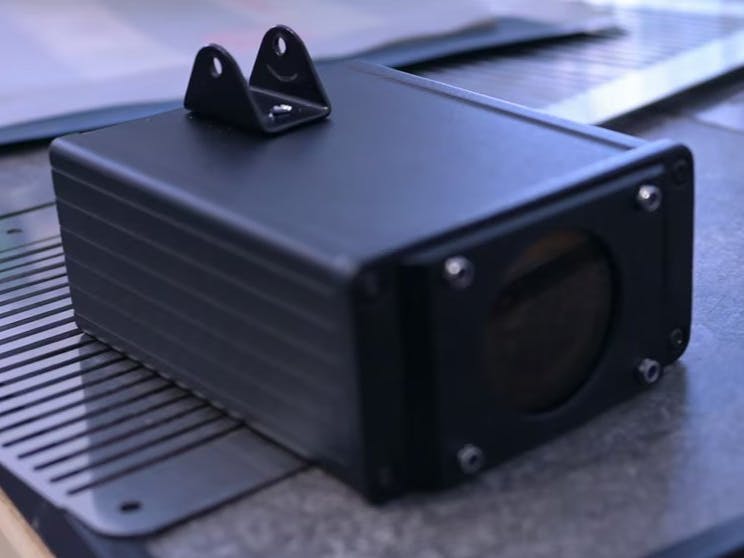
Want a security camera that never phones home to a stranger’s server? Here is the parts list to start: a PocketBeagle 2 single-board computer, a camera module, an 18650 lithium cell for backup power, a Microchip USB2514 hub controller, and a watertight Hammond aluminum enclosure. Add a 5V supply and a custom PCB to tie it together, and you have the bones of a camera that keeps every frame on your own bench.
What Clem Mayer built
Maker Clem Mayer designed the whole system around one goal: keep the footage offline. His camera runs person detection locally, writes recordings to local media, and stays alive through a power outage thanks to the onboard battery. No cloud account, no video stream leaving the house. Recording starts the moment someone walks into frame and stops a few seconds after they leave, so storage fills slowly instead of hoarding empty hallway footage.
How the hardware holds together
The custom PCB is the backbone. It handles power distribution, battery backup, and USB expansion on a single board, which matters because the PocketBeagle 2 has limited native interfaces. The USB2514 hub lets the board talk to the camera, storage, and networking hardware at the same time. Mayer packed everything into the sealed aluminum case and salvaged the front glass and swivel mount from a dummy camera. A heatsink bonded to the housing turns the whole enclosure into a passive heat spreader, which also keeps frost off the front window in cold weather.
One debugging gotcha is worth remembering: intermittent network dropouts turned out to be a small voltage sag under heavy processor load. Nudging the 5V supply output up fixed it. That kind of power-rail detective work is exactly what you hit on real embedded builds.
The software side
Detection runs on OpenCV plus a lightweight deep neural network on the PocketBeagle 2 itself. Footage lives locally and auto-deletes after 72 hours, though extra USB storage stretches that window as far as you want.
Build your own
Full schematics, PCB files, and the bill of materials are on the project write-up at Hackster: the complete build guide. Start with the PocketBeagle 2 and a USB camera on a breadboard, get OpenCV person detection running first, then move to the custom PCB once the software works.
Frequently Asked Questions
What board runs the person detection in this camera?
A PocketBeagle 2 single-board computer handles it, running OpenCV plus a lightweight deep neural network entirely on-device so no video ever leaves your network.
How does the camera keep recording during a power outage?
An onboard 18650 lithium cell feeds the PocketBeagle 2 through its built-in power management, so the system keeps detecting and recording when mains power drops.
What will I learn if I build this?
You will practice custom PCB design, integrating a USB hub controller, on-device computer vision with OpenCV, thermal management inside a sealed case, and power-rail debugging when a voltage sag causes odd network faults.
