
If you have ever wished you could pop the lid off your quadcopter and actually mess with the code, the wiring, or the radio stack, most consumer drones will leave you frustrated. A new pocket-sized flyer aims to change that — and it costs about as much as a nice dinner.
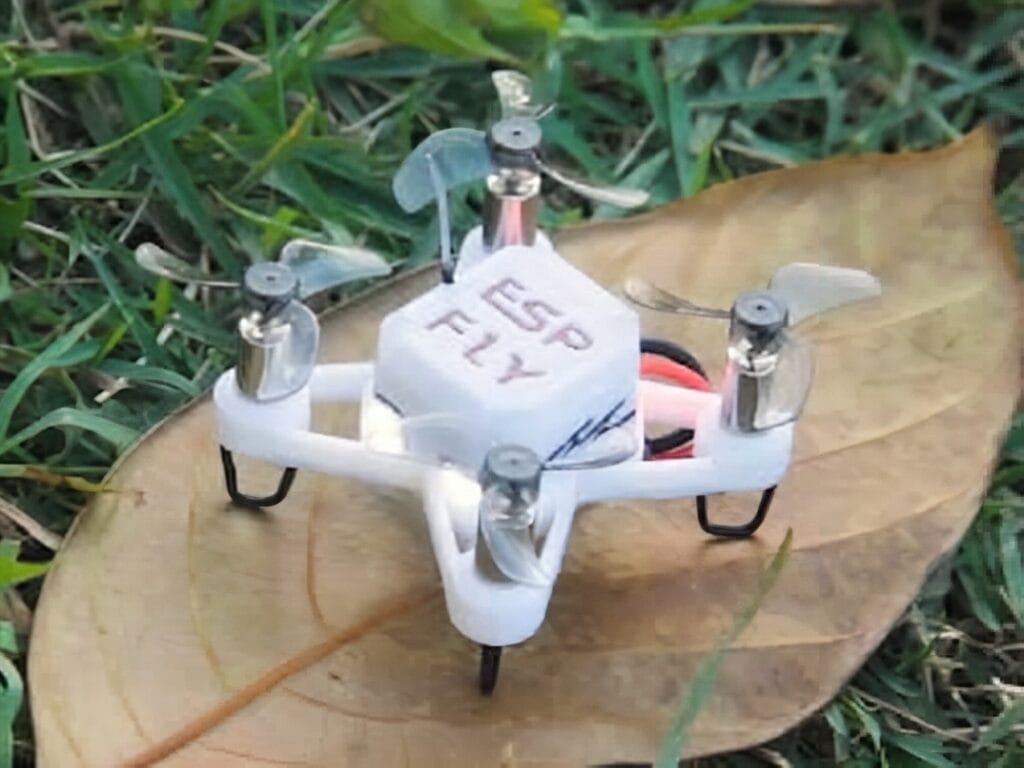
Seeed Studio’s recently announced ESP-FLY is a tiny quadcopter designed from the ground up for tinkering. Instead of a sealed black box of proprietary firmware, you get an open hardware platform built around accessible parts, a 3D-printable frame, and a price tag low enough that the inevitable crash into a wall does not feel catastrophic.
What Makes the ESP-FLY Interesting
The brain of the drone is a XIAO ESP32S3 development board, which handles both flight control and wireless connectivity. A companion sensor-and-driver module pairs it with an inertial measurement unit for stabilization plus the circuitry needed to spin four small brushed motors. The whole craft tips the scale at just 25 grams, thanks to a lightweight printed frame and a 250 mAh LiPo battery, yet it still manages a thrust-to-weight ratio of around 2.7:1 and zips along at up to 40 km/h.
Three Ways to Fly It
- Beginners can pilot it straight from a phone over Wi-Fi — no transmitter required.
- Hobbyists can switch to ESP-NOW or a standard hobby radio for longer range.
- FPV fans can bolt on a 5.8 GHz camera for first-person flight.
Assembly is refreshingly old-school: solder the modular boards together, snap the motors into the frame, flash firmware with the ESP-IDF toolchain, and let the auto-calibration routine handle the rest at first power-up.
Build Something Like It Yourself
You do not have to wait for someone else’s kit to start playing with ESP32-driven flight or robotics. Many of the same building blocks are already on the shelf at Circuitrocks: an ESP32 dev board to host your control loop, a Raspberry Pi Pico as a low-cost alternative, an MPU6050 or similar IMU for orientation sensing, plus jumper wires, breadboards, and small LiPo cells for prototyping. If you would rather stay on the ground, the same parts will happily power a balancing robot, a self-driving rover, or a sensor-rich weather station.
The takeaway: the gap between “watching a cool drone video” and “soldering one together on your kitchen table” has rarely been smaller. Pick a microcontroller, grab a sensor or two, and start hacking.
Frequently Asked Questions
Why use a XIAO ESP32-S3 for flight control instead of an STM32 or dedicated flight controller?
The XIAO ESP32-S3 gives you a 240 MHz dual-core processor, Wi-Fi, Bluetooth, and ESP-NOW all on one tiny board, which means one chip handles both the control loop and the radio link. Traditional STM32-based flight controllers are great but need a separate radio receiver and a more involved toolchain. For a sub-$60 hackable mini drone, the ESP32-S3 keeps part count and complexity low.
ESP-NOW vs Wi-Fi vs hobby radio — which control mode should I pick for this drone?
Use Wi-Fi when you want to fly straight from a phone with no extra hardware (range is short, ~20–30 m line of sight). Switch to ESP-NOW when you want lower latency and longer range with a second ESP32 as your transmitter — usually 100+ m outdoors. Bolt on a standard hobby radio receiver if you already own a transmitter and want the longest range and fastest stick response. Start on Wi-Fi to learn the airframe, then upgrade.
What will I learn from building an ESP32-driven quadcopter like this?
You’ll work with PID loops for attitude stabilization, IMU sensor fusion (accelerometer + gyro), brushed-motor PWM control, and ESP32 wireless protocols — Wi-Fi, ESP-NOW, and optionally PPM/SBUS from a hobby receiver. You’ll also touch flashing with ESP-IDF, calibration routines, and the basics of LiPo safety. These skills carry directly into bigger drones, robotics, and any wireless-controlled embedded project.
