
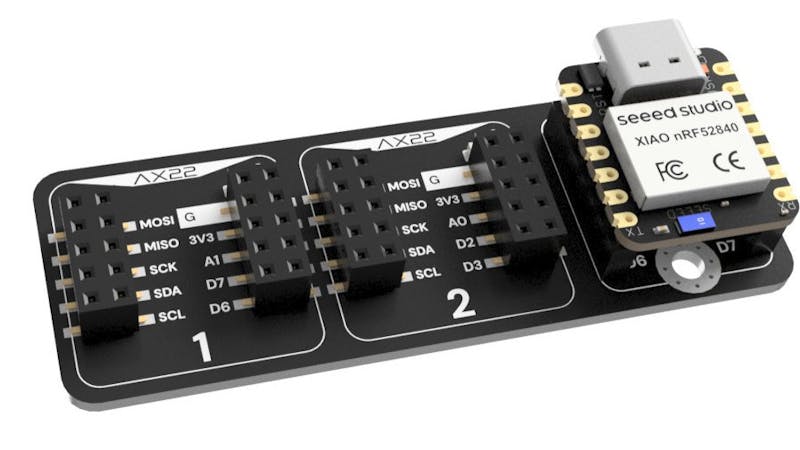
Ask any ECE student what killed their defense demo and you will hear the same answer: a jumper wire that worked all week and quit ten minutes before the panel walked in. In a lab where 40 students share the same tired breadboards, one lifted wire costs half an hour of troubleshooting that nobody budgeted for. Axiometa’s new Genesis XIAO Shield goes straight at that failure mode by deleting the wires entirely.
A two-port backplane for the XIAO family
The shield is a small carrier board with a header for a Seeed Studio XIAO microcontroller on one end and two AX22 expansion ports on the other. AX22 is Axiometa’s square-format module standard, and the catalogue is already past 60 boards: OLED displays, relays, rotary encoders, potentiometers, buttons, radios, motor drivers, and a long list of sensors. A Grove adapter widens that further if you already own Seeed modules. Founder Povilas Dumcius started the Genesis line back in 2024 with an eight-port backplane, then added a four-port Mini. This XIAO version is the smallest of the three.
How the pin mapping works
Plug a XIAO in and it becomes the system’s main microcontroller. The shield routes that board’s power rails, GPIO, ADC, PWM, UART, I2C, and SPI lines onto both AX22 ports using one fixed pin layout. Because every module speaks that same connector, a sensor and a display can swap ports without you rewriting a single pin definition. Your firmware still talks over ordinary Arduino or CircuitPython libraries, so nothing about the code side changes. The obvious limit is the port count: two modules at a time, so an I2C sensor plus an SSD1306 display fills the board. Chain more I2C devices off one port if you need a third, and watch that both share the same 3.3 V rail.
Build it yourself
You need a supported XIAO board (the ESP32-C3 and ESP32-S3 Sense are the usual picks for student projects), the shield itself at $9.99 on Axiometa’s store, roughly PHP 580 landed, and whichever two AX22 modules your build calls for. Stock was empty at the time of writing, so check back before you commit a thesis timeline to it. For a classroom kit where boards get torn down and rebuilt every session, a connector-based system survives a semester better than a bag of DuPont wires ever will. Full write-up and photos are on Hackster, with the technical breakdown on the Seeed Studio blog.
Frequently Asked Questions
Which microcontroller boards work with the Genesis XIAO Shield?
How much does it cost to get started, and how many modules can I connect?
The shield lists at $9.99 (roughly PHP 580 landed), plus the XIAO board and your modules. It carries two AX22 ports at a time, drawn from a catalogue of more than 60 displays, sensors, relays, encoders, and motor drivers. A Grove adapter lets you reuse Seeed modules you already own.
What will I learn if I build this?
You will practise reading a pin-mapping table and matching a peripheral to the right bus, since the ports expose I2C, SPI, UART, ADC, and PWM on fixed pins. You will also get comfortable writing firmware against standard Arduino or CircuitPython libraries and debugging at the code layer instead of chasing loose wires, which is the more transferable skill once you move to a custom PCB.
