
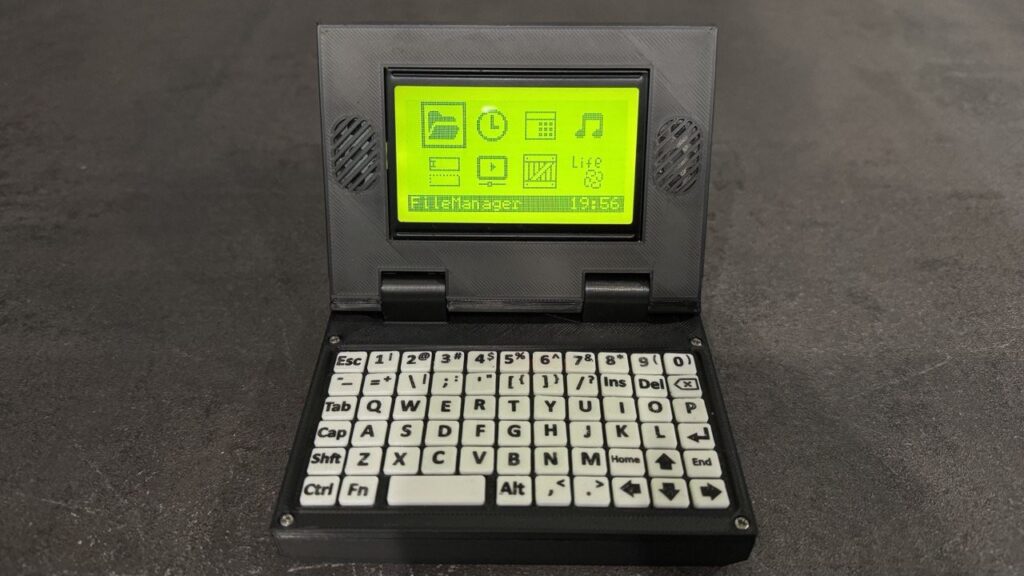
A laptop that plays 24 fps video with sound, runs a notes app, and switches tasks with an alt-tab: normal, until you learn the brain is an 8-bit ATmega2560 on an Arduino-compatible board. That is Vladimir’s AVR Laptop, and it is a good reminder of how much a “small” chip can do.
The ATmega2560 runs at 16 MHz with 8 KB of RAM, which is tiny next to a Raspberry Pi. Vladimir fits a FreeRTOS-based system on it, so video, audio, a game, and a notepad each run as scheduled tasks. The screen is an ST7920 128×64 monochrome LCD, and he skipped the usual library in favor of his own driver that does only what the laptop needs.
Where the tricky parts are
Video is the hard part. At 1-bit color, pushing 24 frames every second while also feeding an audio output leaves almost no spare cycles. A stock LCD library spends too long on generic features, so a custom driver that writes bytes straight to the display is the gotcha that makes the frame rate possible. FreeRTOS adds task switching overhead, so priorities and stack sizes on a chip with 8 KB of RAM need careful budgeting.
The code is waiting on review before release, so you cannot flash it yet. The demo video and write-up are linked from the Hackaday post.
Build it yourself
- Start with an Arduino Mega 2560 and an ST7920 128×64 LCD wired in serial mode (3 data pins instead of 8), then draw a bitmap with a library like U8g2.
- Time one full-screen redraw with micros(). If it takes more than 41 ms, you cannot reach 24 fps, and that number tells you what to optimize.
- Add FreeRTOS from the Arduino Library Manager and run two tasks, one blinking an LED on pin 13 and one reading a button, before attempting audio.
Read the full story on Hackaday, then pick up a Mega 2560 and a 128×64 LCD at circuit.rocks for a thesis-friendly embedded systems exercise.
Frequently Asked Questions
What microcontroller runs the AVR Laptop?
An ATmega2560 on an Arduino-compatible board. It runs FreeRTOS and drives an ST7920 128×64 monochrome LCD through a custom driver.
Can I build this with a regular Arduino Mega?
Likely yes, since the Mega 2560 uses the same chip, but the code is still pending review. You can prototype the display driver and FreeRTOS tasks now.
What will I learn if I build this?
You learn to write a low-level display driver, budget 8 KB of RAM across FreeRTOS tasks, and measure frame timing. These embedded skills suit ECE thesis and capstone projects.
