
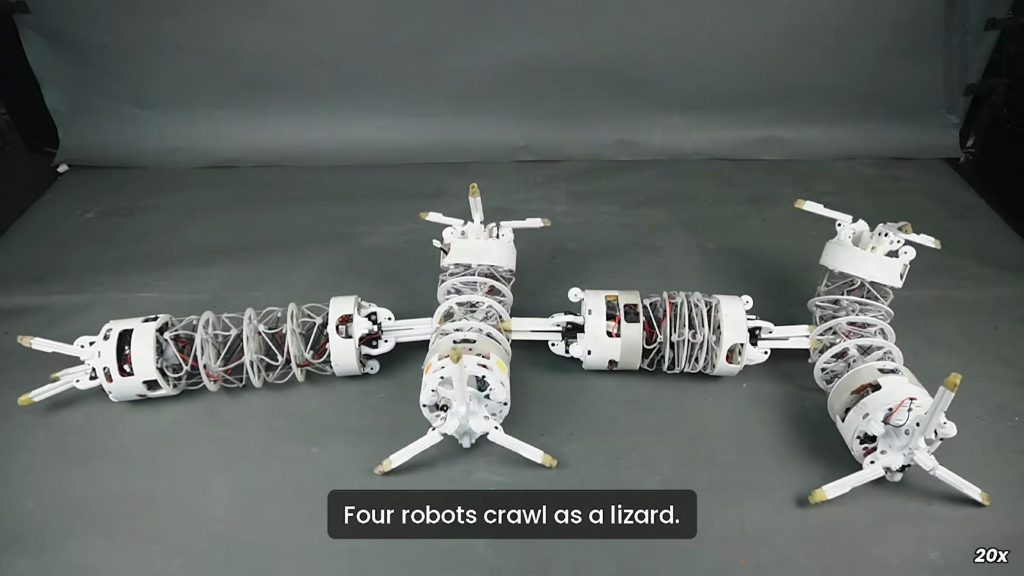
What happens when a soft robot the length of your forearm learns to grab hold of a twin? At Colorado State University the answer is TeCoBot, a worm-like module that crawls, climbs pipes, and lifts a grape without crushing it on its own, then clips onto other units to form chains, loops, and H-shapes when a job is too big for one body. Hackster covered the project this week, and for a school robotics team the interesting part is not the demo but how simple the mechanism underneath turns out to be.
So what is it, exactly?
The name is short for Tensegrity-based Continuum robot. Each unit is 587 mm long, 110 mm across, and weighs about 600 g before batteries. The body is four stacked icosahedral tensegrity cells, and every cell is six carbon-fiber rods floating in a web of stretchy printed TPU tendons. Nothing in the frame is bolted rigidly to anything else, which is why the module can bend double or squash like an accordion and still carry a load. A motorized claw sits at each end. The claws pick up objects, grip pipe walls, and, crucially, grab the claw of a neighbouring robot. In one test two units boosted a third onto a desk, where it put a pen back in its holder, picked up scrap paper, handed it down a chain, and dropped it in a bin. Most of that was teleoperated, but autonomous docking already works with a Raspberry Pi 5, a camera, and printed visual markers.
How does it actually move?
Three lengths of braided fishing line run the full body, spaced around the circumference, each wound onto a spool on a geared DC motor. Shorten one line and the body curls toward it; shorten all three and it contracts. That is the entire actuation scheme, and an ESP32-S3 runs it: the chip takes commands wirelessly from a laptop and drives the three motors, which on a board like this means an H-bridge driver hanging off PWM-capable GPIO pins. The claws use self-locking worm gears, so once closed they hold without drawing current, which matters when a module is dangling from a pipe for minutes at a time. The tricky part in a build like this is not the code but tendon tension: too slack and a cell sags, too tight and the gearmotor stalls before the body bends.
Try it
A single-cell version is a realistic capstone or robotics-club project. You need six 3 mm carbon rods, elastic cord in place of the printed tendons, one N20 gearmotor with a small spool, an ESP32-S3 dev board, and a DRV8833 or L298N motor driver. Get one line pulling first, then add the second and third and write the mixing code that turns a joystick direction into three spool angles. Skip the claws until the body bends reliably. The original write-up, with photos of the chain and loop configurations, is at hackster.io, and the ESP32-S3 pin map you will need for the driver wiring is on the Espressif product page.
Frequently Asked Questions
How do TeCoBot modules connect to each other?
Each module has a motorized claw at both ends driven through self-locking worm gears. The same claw that picks up a grape or grips a pipe wall can close around the claw of a neighbouring robot, and because the worm gear holds without power the link stays locked while the chain moves. Autonomous docking uses a Raspberry Pi 5 with a camera that reads printed visual markers on the other module.
What parts are inside one TeCoBot module?
Four stacked icosahedral tensegrity cells, each made of six carbon-fiber rods held by stretchy 3D-printed TPU tendons, give a body 587 mm long and 110 mm across at about 600 g without batteries. Three braided fishing lines run the length of the body and wind onto spools on geared DC motors, and an ESP32-S3 microcontroller receives wireless commands and drives those motors plus the two claws.
What will I learn if I build this?
A one-cell version teaches tensegrity structure design, tendon-driven actuation, and the mixing math that turns a direction command into three motor positions. On the electronics side you will wire a DC gearmotor to an H-bridge driver, generate PWM on ESP32-S3 GPIO pins, and send commands over Wi-Fi, all of which transfer directly to a soft-robotics thesis or a robotics competition entry.
