
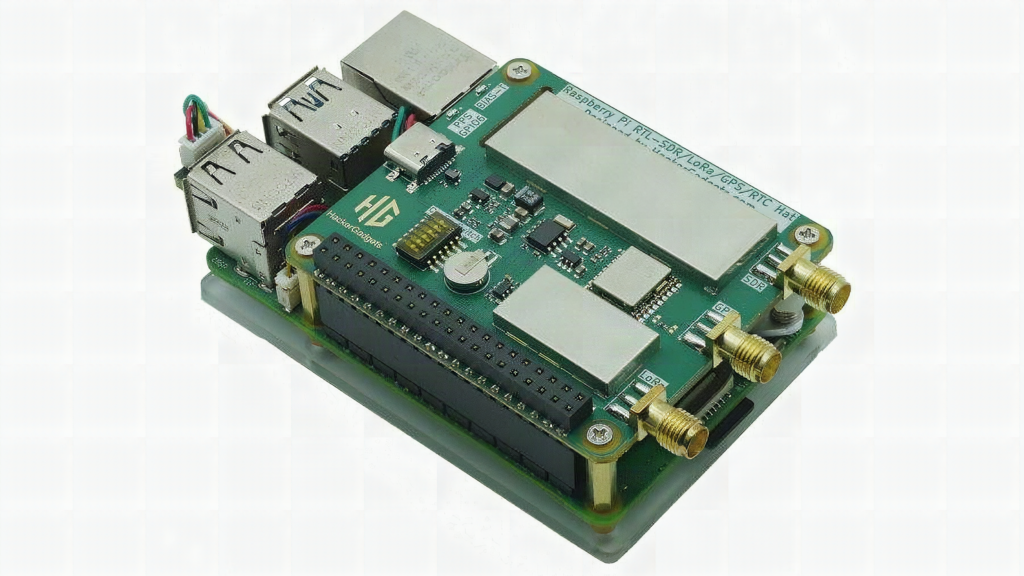
Here is the shopping list: one Raspberry Pi (anything from a Zero up to a Pi 5), a microSD card with Raspberry Pi OS, a USB power supply, three antennas, and a new HAT from maker Deng Dazhong that stacks a receive-only software-defined radio, a LoRa transceiver, and a GNSS receiver onto the 40-pin header. The HAT is on pre-order for US$84.90 at Hacker Gadgets; standoffs are in the box, antennas are not. Budget a 915 MHz whip for LoRa, a 1090 MHz stub for aircraft tracking, and an active GPS patch antenna.
What the board actually does
Dazhong built it for people who keep running out of USB ports. Instead of a dongle for SDR, a second for GPS, and a LoRa breakout on jumper wires, everything sits on one PCB flush against the Pi, connected through the GPIO header plus a single USB port. The compatibility list runs from the Pi 3 Model B through the Pi 5 and the Zero line. The pitch is wide: scan the spectrum with SDR++ or GQRX, decode ADS-B from passing aircraft, run an off-grid Meshtastic text relay that reaches tens of kilometres, log a drone’s track with multi-constellation GPS, or timestamp remote sensor readings with a clock that survives a reboot. RTL-SDR.com, which first flagged the project, has a write-up at rtl-sdr.com.
The three radios and the clock
The SDR side is the familiar RTL2832U demodulator paired with an R860 tuner, the same silicon inside cheap DVB-T dongles, covering roughly 100 kHz to 1.74 GHz in receive only. That part is why the USB link exists: the rtl-sdr library expects to find the chip as a USB device. The LoRa radio is a Semtech SX1262 on SPI through the header, and it works with the Linux-native meshtasticd daemon out of the box. Pick the right regional preset (Meshtastic has PH_433, PH_868, and PH_915 entries for the Philippines) before you transmit. The GNSS receiver is an unnamed multi-constellation module on the Pi’s UART, so free up the serial port in raspi-config and point gpsd at it. A battery-backed NXP PCF85063A real-time clock sits on I2C at address 0x51 and keeps your timestamps honest when the Pi boots with no network and no GPS fix yet. One gotcha: the header and the SX1262 are both 3.3 V parts, so any extra sensor you hang off the spare pins needs to be 3.3 V too.
Worth the wait?
For a thesis on LoRa sensor networks or a school station that wants both a spectrum view and a precise clock, this is a tidy bundle at close to what three separate modules cost. The catch is delivery: Dazhong says the shipping estimate on the listing changes often, so check it before you order. If you would rather start this week, an RTL-SDR Blog V4 dongle plus an SX1262 breakout covers two of the three radios, and the Meshtastic Linux guide at meshtastic.org walks through the SPI setup. Full details and the original board photos are on Hackster at hackster.io.
Frequently Asked Questions
Which radios are on this Raspberry Pi HAT?
Three: a receive-only RTL2832U/R860 software-defined radio covering about 100 kHz to 1.74 GHz, a Semtech SX1262 LoRa transceiver with Meshtastic support, and a multi-constellation GNSS receiver. A battery-backed NXP PCF85063A real-time clock keeps time when there is no network or GPS fix. The SDR uses one USB port; the LoRa, GNSS, and RTC go through the 40-pin header over SPI, UART, and I2C.
What does it cost and which Raspberry Pi models does it fit?
The HAT is US$84.90 on pre-order from Hacker Gadgets, with standoffs included but no antennas, so add a LoRa whip, a 1090 MHz or wideband SDR antenna, and an active GPS patch. The maker lists compatibility from the Pi 3 Model B through the Pi 4, Pi 5, and Pi Zero family. Shipping estimates on the listing change often, so check the date before ordering.
What will I learn if I build with this HAT?
You get hands-on time with three different Linux radio stacks on one board: the rtl-sdr library and GQRX or SDR++ for spectrum work, meshtasticd over SPI for LoRa mesh networking, and gpsd over UART for positioning. Along the way you learn to enable SPI, I2C, and the serial port in raspi-config, read an RTC over I2C, and pick a legal LoRa region preset, all of which carry straight into an IoT thesis or a school sensor-network project.
