
What do you do when your car’s engine computer is older than the diagnostic port that every scanner on the shelf expects?
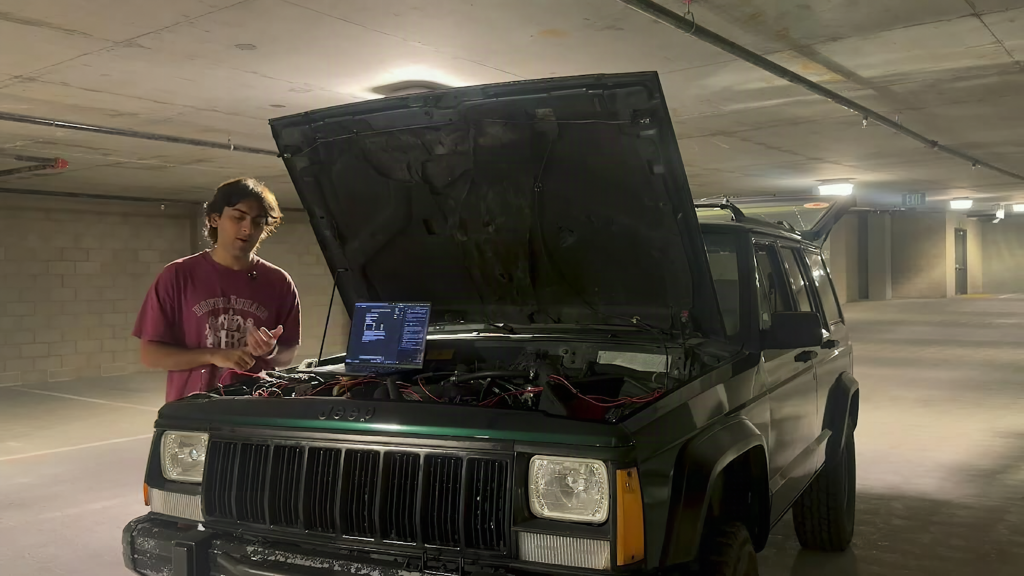
That was the spot Muhammad Zulali landed in with his 1994 Jeep Cherokee. California’s smog test runs the vehicle on a dynamometer, and during the 25 mph portion the Jeep kept pushing out too much nitrogen oxide. A 1994 Chrysler has no OBD-II port; that standard only became mandatory on 1996 models. Instead the Powertrain Control Module (PCM) talks over Chrysler’s own Serial Communication Interface, or SCI, and the dealership scan tools that spoke it are nearly extinct. Zulali went another way: a $3 Arduino Nano clone on a breadboard, a laptop running Claude Code and Codex, and about a week of reverse engineering.
How does a Nano talk to a 1994 engine computer?
SCI is a serial link, but not one you can plug into a USB-UART adapter and read. The protocol uses inverted logic compared to a normal UART idle state, and the PCM is fussy about timing between bytes. The low-speed SCI rate documented for these Chrysler modules is 7812.5 baud, which no stock Serial.begin() default covers. Zulali’s Nano runs custom firmware that handles the Chrysler framing on one side and presents a plain USB serial port to the laptop on the other. The first gotcha came from the breadboard itself: the resistors added to protect the Nano’s pins loaded down the SCI line, which is a weak signal to begin with, and nothing came through. Claude Code flagged the resistor network as the likely culprit, the resistors came out, and live data started streaming: coolant temperature, battery voltage, fuel delivery, all logged while driving.
Reading was one thing. Fixing the calibration meant writing to the PCM, and here the project hit a wall. The module was built in December 1993, a few months before Chrysler added the hardware needed for flash reprogramming, so the firmware had hooks for it but the board did not. Codex’s first workaround was to inject a small routine straight into RAM over SCI and re-send it about 90 times per second so it would keep running. It worked, but a patch that vanishes the moment the serial link hiccups is no way to drive to a test station. Codex eventually found a way to park the custom code in nonvolatile memory so it executes on its own. Along the way the pair found a California-specific calibration quirk that leaned out fuel delivery in certain conditions, which drives NOx up. With fuel delivery corrected, the Jeep passed smog.
Try it, carefully
Do not start with your daily driver’s engine computer. Start with the cheap half of this build: a breadboard, an Arduino Nano (circuit.rocks carries the Nano V3 at circuit.rocks/products/arduino-nano), and SoftwareSerial or a bit-banged UART at a non-standard baud rate. Practice on a junkyard ECU, or on a second Arduino pretending to be the PCM, before you touch anything bolted to a running engine. Zulali’s full walkthrough is on YouTube at youtube.com/watch?v=WPj3aQ-xxpI, and the Hackster write-up at hackster.io covers the RAM-injection detour in more detail.
Frequently Asked Questions
Why couldn’t a normal OBD-II scanner read this Jeep?
OBD-II only became mandatory on 1996 model-year vehicles. The 1994 Cherokee’s PCM uses Chrysler’s proprietary Serial Communication Interface (SCI), which needs its own baud rate, inverted logic and timing, so a generic scanner or USB-UART adapter sees nothing useful.
What parts did the interface actually need?
An Arduino Nano clone (about $3, or roughly PHP 200 to 400 locally), a breadboard, jumper wires and a laptop. The protective resistors first added to the circuit had to be removed because they loaded down the weak SCI signal. The firmware and the PCM analysis were written with Claude Code and Codex.
What will I learn if I build this?
Non-standard serial protocols (custom baud rates, inverted idle states, inter-byte timing), how to log live sensor data from a microcontroller to a PC, and the basics of reading a firmware dump. For an ECE thesis, the safe version is a two-Arduino SCI emulator on the bench, not a running engine.
