
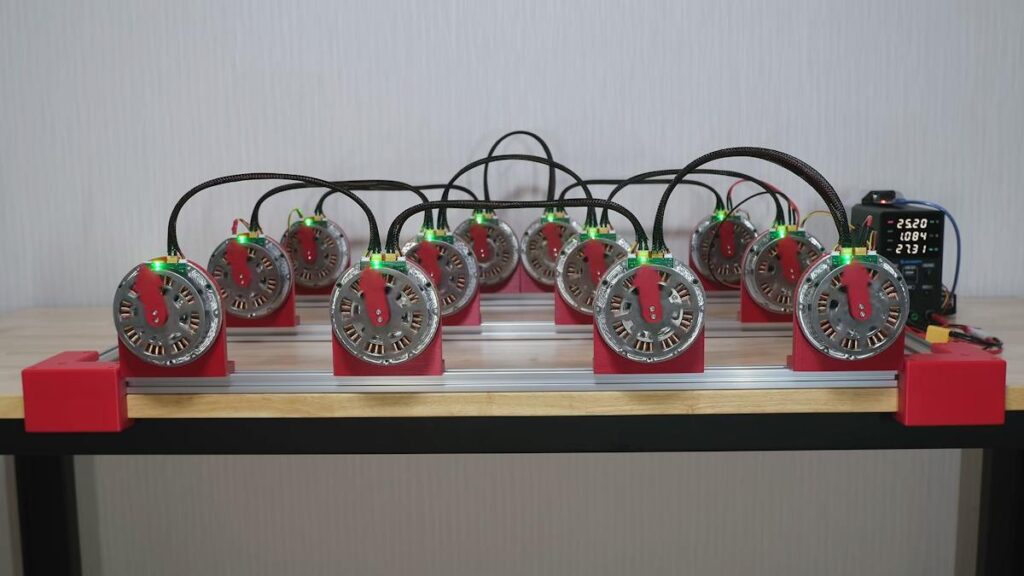
Walking robots live or die on their joints. A quadruped needs 12 actuators that are strong enough to launch the body yet soft enough to soak up each footfall, and commercial quasi-direct-drive units sell for a few hundred US dollars apiece. Twelve of those blow past most thesis budgets. That is why this build from YouTuber Koshiro Robot Creator matters: a from-scratch actuator cheap and simple enough to make a dozen of, with the CAD and PCB files released as open source.
What Koshiro built
Each actuator sandwiches a pancake-style brushless motor between two CNC-machined aluminium plates, with a large bearing carrying the rotating assembly. A custom PCB on the back runs field-oriented control (FOC), reads a magnetic encoder for shaft position, and exposes connectors so power and the comms bus daisy-chain from one joint to the next. That keeps 12-joint wiring sane. Unlike commercial actuators that bury the gearbox and electronics inside the stator, Koshiro bolted both on the outside. The unit is bulkier, but assembly is easier and the 3D-printed gearbox stays away from the motor’s heat, so the plastic does not creep. The gearbox itself is a 9:1 cycloidal drive: two offset disks wobble inside a ring of pins, spreading each impact across many contact points instead of a few gear teeth. For printed parts taking a running foot’s shock, that load sharing is the point.
The numbers from the bench
Before the gearbox went on, the bare motor spun to 600 RPM under the custom controller, and impedance control let it behave like a virtual spring and damper, which is exactly what a leg wants when it lands. With the 9:1 reduction fitted, output speed dropped to about 67 RPM while torque climbed: roughly 10.5 N·m at peak load against a theoretical 17.64 N·m. The gap comes from friction in the sleeve bearings and flex in the printed cycloidal disks. Even so, the joint stayed backdrivable, and position and impedance control were smooth. Koshiro then machined all 24 plates, assembled 12 driver boards, and printed every gearbox for the full set. Next step: three actuators into one working leg, then the complete dog.
Build one yourself
Start with a single joint before you commit to twelve. The design files live on Koshiro’s GitHub, and the build videos are on the Koshiro Robot Creator channel; the Hackster write-up has the photos. If you would rather prototype the electronics on familiar parts, the SimpleFOC library on an ESP32 driving a DRV8313 stage will close an FOC loop on a 5010-class gimbal motor, with an AS5600 magnetic encoder on I2C for feedback (pull-ups are on most breakouts, but check with a multimeter). The gotcha that bites first-timers: the encoder magnet must be diametrically magnetised and centred on the shaft to within about 0.5 mm, or your position readings wobble once per turn and the controller hunts. An ESP32 dev board, AS5600 breakout and FOC driver come to roughly 1,500 to 2,000 pesos at circuit.rocks before the motor.
Frequently Asked Questions
Why does this actuator use a cycloidal gearbox instead of a planetary one?
A 9:1 cycloidal drive spreads load across many pins and two offset disks rather than a handful of gear teeth, so 3D-printed parts are far less likely to strip or crack when a robot foot slams into the ground. Koshiro mounted the gearbox outside the motor so it stays away from the heat that would deform the plastic.
How much torque and speed does each joint deliver?
The bare motor runs to about 600 RPM. With the 9:1 reduction, output drops to roughly 67 RPM and peak torque measured around 10.5 N·m, against a theoretical 17.64 N·m. The losses come from sleeve-bearing friction and flex in the printed disks, but the joint stays backdrivable with smooth position and impedance control.
What will I learn if I build this?
Field-oriented control of a brushless motor, reading a magnetic encoder for closed-loop position, impedance control that makes a joint act like a spring and damper, cycloidal gear design, and the practical side of PCB assembly, CNC parts and daisy-chained power and comms. It is a complete mechatronics capstone in one joint.
