
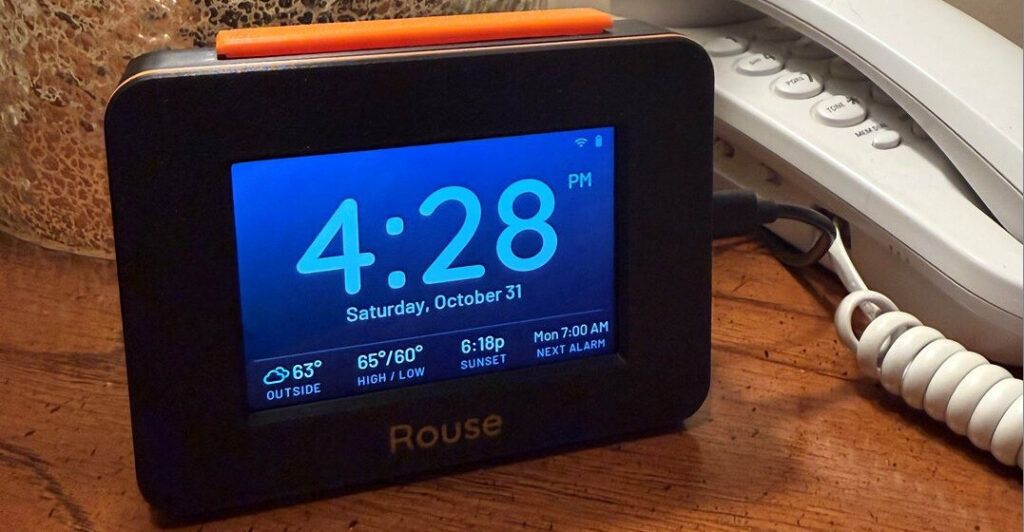
Grab an ESP32-S3 touch board or a Cheap Yellow Display (CYD), a small speaker, a couple of buttons and a USB cable, and you have the hardware for a bedside alarm clock that never phones home. The firmware is called Rouse, and Hackaday covered it this week.
What Rouse does
Smart displays from the big tech companies show the weather and family photos next to the time, then push ads and collect data you never agreed to share. Rouse copies the useful part and drops the rest: no user account, no subscription, no phone app that stops working in three years. You configure it from a web page served by the board itself, so any browser on your WiFi can set alarms.
It targets common boards such as the Waveshare ESP32-S3-Touch and the CYD, which pairs an ESP32 with a 2.8-inch, 320×240 touchscreen. Firmware updates can run over the network, but only after you approve them.
Parts and wiring notes
- The ESP32-S3 runs at up to 240 MHz on 3.3 V logic, and the whole clock runs from a 5 V USB charger.
- Buttons wire between a GPIO pin and ground with the internal pull-up enabled, so no external resistors are needed.
- A small speaker needs an amplifier module, usually I2S or a DAC pin, and the pin choice is the tricky part. Check the build guide for your exact board before you solder anything.
The project also ships files for a printed enclosure, though a plain project box works just as well. Because the web interface lives on the device, you can read the library code and confirm for yourself what network traffic it makes.
Wrap-up: try it this weekend
Flash Rouse to a CYD first, since it needs no wiring for the display and touch. Set one alarm from your phone’s browser, then add the speaker and buttons. For a thesis or capstone, the interesting extension is a local-only schedule sync, and a school lab can build a dozen of these without any cloud accounts. Boards and speakers are available at circuit.rocks.
Frequently Asked Questions
Which boards can run Rouse?
Does Rouse need an account or phone app?
No. It serves a web interface from the board for configuration, and firmware updates over the network happen only after you approve them.
What will I learn if I build this?
You practice flashing ESP32 firmware, wiring buttons with internal pull-ups, driving a speaker, and configuring a device through a local web server. These skills carry over to most IoT thesis projects.
