
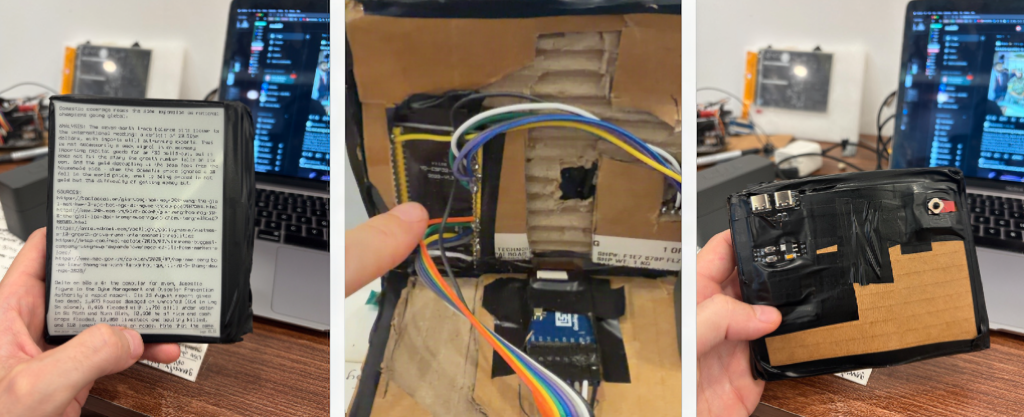
A Kindle-style reader costs real money, and a student who builds one learns more than one who buys one. Allan Binder of MUON SORTES shared a how-to for an e-reader that lands between $35 and $60 (roughly PHP 2,000 to 3,500), and the parts list fits on one hand.
What the build is
The Adafruit write-up lists four things: an ESP32-S3 dev board, an e-paper panel with its adapter board, a five-way button module, and a way to power it. The ESP32-S3 earns its place with built-in WiFi, enough flash to hold a few books, and a hardware SPI bus that drives the panel at full speed. Binder suggests a board with 8 MB or 16 MB of flash; 4 MB boards work but leave little room for text.
Wiring and parts gotchas
- The five-way navigation module (up, down, left, right, center click) wires with one common leg to ground and five signal legs to free GPIO pins. Turn on the internal pull-ups in code and you need no resistors.
- The e-paper panel talks over SPI: MOSI, SCK, CS, DC, RST and BUSY, plus 3.3 V and ground. Wrong BUSY pin is the classic reason a panel stays blank.
- A BME280 breakout on SDA/SCL adds temperature and humidity to the status line for a couple of dollars. It is optional.
E-paper only draws power while it refreshes, so a small LiPo can run a reader for weeks of page turns. A full refresh takes a second or two, which is tricky to get used to; partial refresh is faster but leaves ghosting, so most firmware does a full refresh every 10 or so pages.
Build it yourself
Start by proving the panel works: load the vendor’s SPI demo, confirm the image, then add the buttons. Next, store a plain .txt file in flash and page through it 20 lines at a time. For a thesis or capstone, the WiFi side is the interesting part: fetch a book or a school handout over HTTP and cache it to flash. Parts like ESP32 boards and breakouts are stocked at circuit.rocks, and the full guide is on Binder’s Instagram and the Adafruit post linked above.
Frequently Asked Questions
Why use an ESP32-S3 for an e-reader?
It has built-in WiFi, enough flash (8 MB or 16 MB recommended) to store several books, and a hardware SPI bus that drives the e-paper panel at full speed.
How much does the e-reader cost to build?
The guide puts the total between $35 and $60 depending on the e-paper panel. An optional BME280 sensor for the status line adds a couple of dollars.
What will I learn if I build this?
You learn SPI wiring for displays, button input with internal pull-ups, flash storage and paging text, and e-paper refresh behavior. These skills carry over to most thesis-level embedded display projects.
