
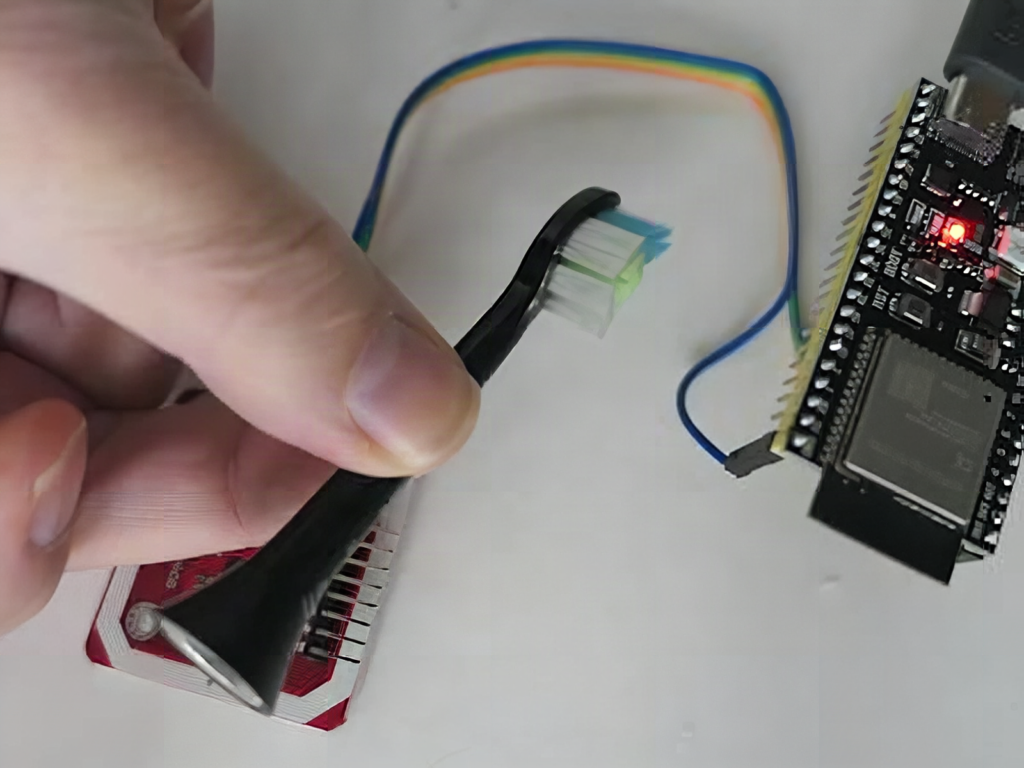
Parts list first: one ESP32-S3 dev board, one PN532 NFC module, four jumper wires, and a used Sonicare brush head. That is the whole bench setup YouTuber Circuit Helper used to read the chip hiding in a toothbrush, as covered by Hackster.
What is actually inside the brush head?
A small brown dot near the base of the head covers a passive NFC chip with no battery. The handle’s reader field powers it at 13.56 MHz, and the chip answers with stored data. Circuit Helper wired the PN532 to the ESP32-S3 over I2C (SDA and SCL, plus 3.3 V and GND) and streamed the memory dump to a PC app.
What did the dump reveal?
Comparing a new head against a worn one showed a brushing-time counter in seconds, power-level data, and a wear value. One used head logged over five hours. Brushing hard makes the pressure sensor multiply the recorded time, so an aggressive brusher burns through a head faster. The memory is password protected, yet open source tools from earlier reverse engineering work could write new values, and a worn head was edited to report 50% life left.
The gotcha for anyone copying this: the PN532 needs its DIP switches or jumpers set to I2C mode, and many cheap red boards ship in SPI or HSU mode. If your scanner shows nothing, check that first, then confirm the I2C pull-ups sit near 4.7k ohms.
Where does the unlock trick come in?
He cut the chip and its antenna coil out of an old head and used it as an NFC token that unlocks a computer. A coil that small gives a short read range, so keep the token within a centimeter or two of the reader.
For a thesis or class demo, an ESP32 board and a PN532 module from circuit.rocks cost far less than most sensor kits, and the same read-and-write setup works on door-access cards. Watch the full teardown at Hackster and try dumping an old gym card before you touch any toothbrush.
Frequently Asked Questions
How was the toothbrush chip read?
A PN532 NFC module on I2C, driven by an ESP32-S3, generated a 13.56 MHz field that powered the passive chip and sent its memory to a PC app.
What parts and skills does a copy need?
An ESP32 board, a PN532 module, jumper wires and a USB cable. You need basic I2C wiring and a library for NFC reads; no soldering is required for breakout boards with headers.
What will I learn if I build this?
You will learn I2C wiring, NFC tag memory layout, comparing memory dumps to find counters, and why password-protected tags still deserve scrutiny, useful for thesis projects in embedded security or access control.
