
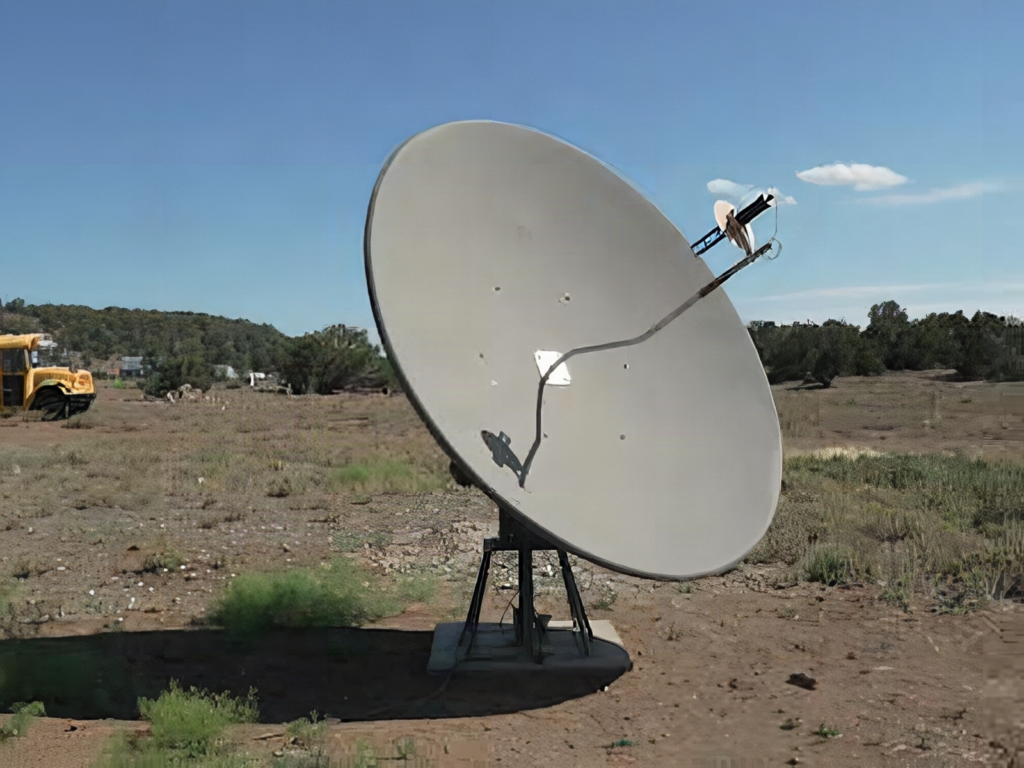
An eight-foot dish rusting on a plot of land is either scrap or a ground station waiting to happen. Cranktown City picked the second option, and the Hackster write-up of his build shows how far a Raspberry Pi and a few salvaged parts can go.
What he built
The dish came with a motorized elevation mount, so the missing piece was azimuth. He added a rotating base driven by a wheelchair motor with a built-in worm gear and a sprocket. The first design needed a rebuild, which is normal for anything with 8 feet of steel on a turntable. Magnetic encoders report the dish position back to the controller.
How the pointing and receiving work
A Raspberry Pi drives the motors through heavy-duty driver modules and pulls satellite positions from online databases. Because the dish never moves, its latitude and longitude are fixed, so the azimuth and elevation for any pass are a short calculation. At the dish focus sits a helical antenna on a 3D-printed scaffold, feeding an amplifier, then an RTL-SDR dongle, then the Pi. The decoding software is SatDump, which handles a wide range of satellite downlinks. The tricky bit for newcomers is gain: too much from the amplifier and the SDR overloads, so start low and raise it in steps.
Build it yourself
Skip the 8-foot dish for a first attempt. A 1 m offset dish, an RTL-SDR v4 and a Pi 4 with 2 GB of RAM is enough to pick up weather satellites near 137 MHz or 1.7 GHz HRPT-class signals with a suitable feed. For a classroom version, drive a small azimuth/elevation mount with two stepper motors on an Arduino or ESP32, and let the Pi send target angles over USB serial. Test the motion first with a pull-up button on a spare GPIO pin as a home switch, then add the encoder. Grab the SatDump code from github.com/SatDump/SatDump, and check circuit.rocks for stepper drivers and Raspberry Pi boards.
Frequently Asked Questions
How does the ground station know where to point?
A Raspberry Pi pulls satellite positions from online databases and, since the dish stays in one spot, calculates the azimuth and elevation for each pass. Magnetic encoders confirm the dish reached that angle.
What hardware does a smaller version need?
A dish or helical antenna, an amplifier, an RTL-SDR dongle, a Raspberry Pi running SatDump, and two motors with drivers for azimuth and elevation. A 1 m dish and a Pi 4 are a sensible starting size.
What will I learn if I build this?
You learn motor control with encoder feedback, converting satellite orbit data into pointing angles, antenna basics like gain and focus, and software-defined radio decoding. These skills fit thesis work in communications and robotics.
