
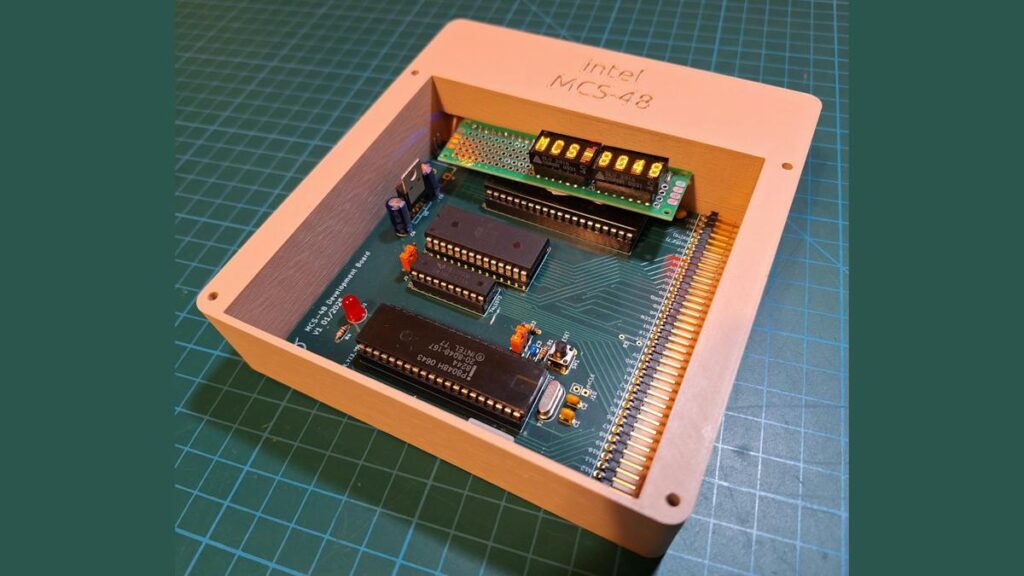
Got a free Saturday and a drawer of old logic chips? A 1976 Intel 8048 can become a name badge in one weekend, and mwfeurtado’s build shows how little hardware it takes. The goal was a badge for the Vintage Computer Festival Southwest that nobody else would be wearing.
What they built
The 8048 is an 8-bit microcontroller with 27 GPIO pins and clocks up to 11 MHz. Its program lives in mask ROM, which you cannot rewrite, so the builder pulled a trick: tie the External Access (EA) pin high and the chip runs code from an external EEPROM instead. An SN74HC573 latch splits the shared address and data bus, an Intel 8155 adds RAM and extra I/O, and a 7805 regulator turns a 9 V supply into 5 V. A 40-pin RCBUS header brings out the rest.
The badge itself is two OSRAM SLY2016 displays, four 5×7 yellow LED characters each, wired onto perfboard. They take 7-bit ASCII, so no font tables are needed. At power-up it scrolls “Hello! My Name is MCS-8048 1976 Intel MCU.”
Parts and cost reality
The tricky bit is sourcing. The 8048, 8155 and SLY2016 are all vintage or surplus parts, so buy spares and check pinouts against datasheets before soldering. The displays hang off GPIO pins on the 8155, with separate write lines choosing the left or right module, so there is no address-decoding logic to build. Rough budget for a student version: a few hundred pesos for the latch, EEPROM, crystal and regulator, plus whatever the surplus chips cost you.
Spend your Sunday on this
No 8048 on hand? Copy the idea with an Arduino Uno or ESP32: drive a 16-character display from a shift register, and write the scroll routine in a few lines of C. Writing the same routine in 8048 assembly teaches you more about buses and latches than any datasheet. Full build log: Hackster.io. Header pins, perfboard, 74HC573 latches and breadboards are stocked at circuit.rocks.
Frequently Asked Questions
How does the Intel 8048 run code without reprogrammable flash?
Tying the External Access (EA) pin high makes the chip fetch instructions from an external EEPROM instead of its internal mask ROM. An SN74HC573 latch demultiplexes the shared address and data bus.
What parts does the badge use?
An Intel 8048, Intel 8155 RAM and I/O chip, SN74HC573 latch, EEPROM, 8 MHz crystal, 7805 regulator, and two OSRAM SLY2016 four-character LED displays on perfboard.
What will I learn if I build this?
You learn external program memory, address latching, memory-mapped I/O and assembly routines for 7-bit ASCII displays. These ideas carry over to any microcontroller thesis or embedded systems class.
