
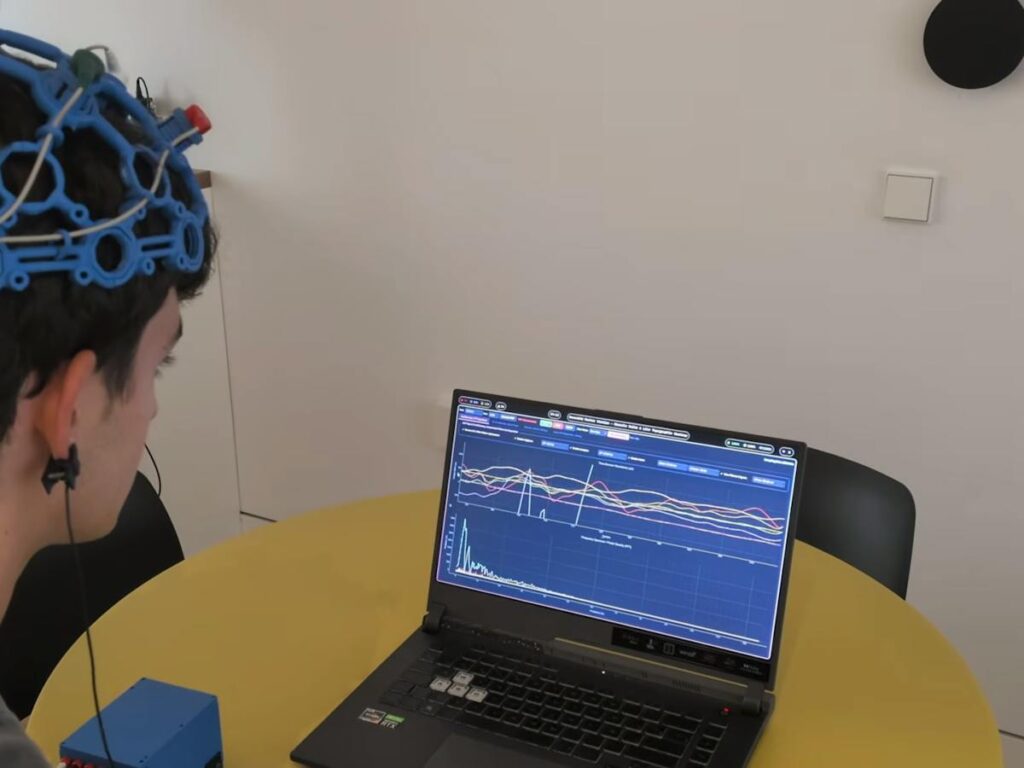
Treat a brain-computer interface as a weekend project and it stops sounding like lab equipment. Carlos Lorenzo-Zúñiga Marí built an eight-channel EEG headset for under $350 (roughly PHP 20,000), and the interesting parts are a single PCB, an ESP32, and some careful grounding.
What the builder made
The headset reads brain signals through spring-loaded dry electrodes, so there is no conductive gel to deal with. Electrodes follow the International 10-20 layout, borrowed from the open source OpenBCI headwear design. Ear-clip electrodes drive a bias circuit that cancels noise common to every input. The data streams out over the ESP32‘s Wi-Fi.
Parts and cost reality
- Front end: TI ADS1299, an 8-channel, 24-bit ADC made for biopotentials
- Brain: ESP32 on the same 4-layer PCB, with a dedicated ground plane splitting analog from digital
- Motion check: a 6-axis IMU plus a small decision tree that flags head movement as artifact
- Power: a LiPo cell and a galvanic isolator, never mains while electrodes touch your scalp
The signal you want is only 10 to 100 microvolts, so mains hum, chargers, and jaw muscles easily drown it out. With the inputs shorted, his board measured a noise floor near 1 microvolt. The gotcha he hit: USB power back-fed the 3.3 V rail. Instead of respinning the board, he made a USB adapter that cuts the 5 V line and keeps the data pins.
No ready-made ADS1299 library fit his needs, so he wrote a driver using SPI, DMA, and double buffering. Samples land in memory without tying up the ESP32 CPU during continuous capture.
Spend your Sunday on this
You do not need to build the whole headset. Saturday, order an ADS1299 breakout and read its ID register over SPI from an ESP32 to confirm your wiring. Sunday, short the inputs and log the noise floor, then try a clean ECG or EMG on your forearm before chasing EEG alpha waves. That sequence mirrors how the builder validated his board, and it makes a solid thesis seed for biomedical instrumentation students.
Read the full story on Hackster. For the ESP32 side of the practice rig, check the ESP32 dev boards at circuit.rocks, and keep the battery pack separate from any wall adapter.
Frequently Asked Questions
How does this headset measure brain signals?
An ADS1299 8-channel, 24-bit ADC reads the voltage difference between electrodes, and an ear-clip bias circuit cancels noise shared by all inputs. The ESP32 on the same PCB streams the samples over Wi-Fi.
What does the build cost and require?
The builder kept it under $350 using a custom 4-layer PCB, dry electrodes, an ESP32, an IMU, and a LiPo battery. You need PCB layout skills, SPI driver coding, and care with analog grounding.
What will I learn if I build this?
You will practice analog front-end design, separating analog and digital grounds on a PCB, writing an SPI plus DMA driver, and judging noise floor in microvolts. It fits a biomedical or instrumentation thesis.
