
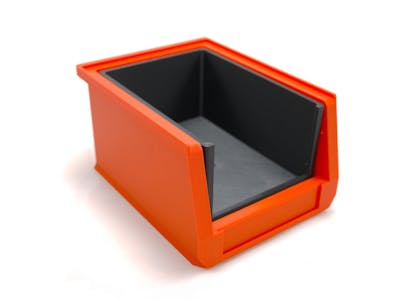
Counting 220-ohm resistors by hand is the part of workshop life nobody misses. To automate it you need three things: a bin that weighs its own contents, a controller that can poll dozens of those bins at once, and a server that turns grams into part counts. Slant Tech’s warecache ecosystem packages all three, and the hardware documentation is open enough that you can copy the approach on a bench.
What the system actually does
Instead of asking you to type quantities into a database, warecache measures what is sitting in each bin. Weight Sensor Bins handle loose stock, with variants covering a few hundred grams of small passives up to 10 kg of hardware. Switch Sensor Bins take the other approach: individual slots that report present or absent, which suits tools, connectors, and anything too irregular to weigh reliably. Every bin carries an EEPROM holding a serial number and its own configuration, so pulling a bin off the shelf and moving it does not scramble the count.
The electronics underneath
The bins hang off a Container Controller built around an STM32H723 running FreeRTOS. One controller drives up to 64 bins across an 8×8 switched I2C matrix, and that switching is the clever part: address collisions are the usual wall you hit when you fan out 64 identical sensor boards, and a matrix sidesteps it instead of demanding 64 unique addresses. The controller pulls power and network from PoE Ethernet, mounts as a USB flash drive when you need to edit config files or drop in certificates, and exposes FDCAN and RS-485 for factory gear. Readings travel over encrypted MQTT to a self-hosted server that ships as a Linux binary or a Docker image, with distributor plugins pulling pricing and stock data against your BOM. Firmware, server, and both clients are GPLv3, and the hardware release includes controller schematics, KiCad sensor templates, and STEP files for the enclosures.
Clone it at one-bin scale
You do not need 64 bins to steal the idea. An HX711 amplifier, a 1 kg load cell, and an ESP32 will weigh one drawer and publish the count over MQTT for well under PHP 1,000 in parts. The tricky bits are tare drift as the room warms up, and picking a per-part mass consistent enough that 50 screws don’t read back as 47. Start with one bin of something uniform, calibrate against a hand count, then add bins once the numbers hold overnight. Full spec rundown and the Crowd Supply signup are on Hackster.
Frequently Asked Questions
How does warecache know how many parts are left in a bin?
Weight Sensor Bins measure the mass sitting in the bin and divide by a calibrated per-part weight, so the count updates as you take parts out. Switch Sensor Bins skip weighing and use per-slot detection for larger items. Each bin stores its own serial number and configuration in an EEPROM, so the server still recognises it after you move it.
What hardware do I need to build a scaled-down version?
One load cell, an HX711 amplifier board, and any Wi-Fi microcontroller such as an ESP32 is enough for a single smart bin. Publish the reading over MQTT to a broker like Mosquitto on a Raspberry Pi. Expect to spend under PHP 1,000 per bin, versus a Container Controller that handles 64 bins over PoE.
What will I learn if I build this?
Load cell wiring and tare calibration, reading an ADC over I2C or SPI, and handling drift in an analog measurement that has to stay accurate for weeks. On the software side you pick up MQTT publish and subscribe, JSON payload design, and running a self-hosted broker. That combination covers most of what an IoT sensor node thesis chapter needs.
