
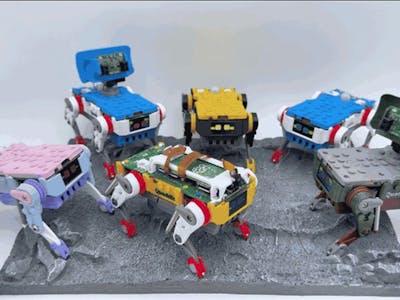
Weekend hack idea: a quadruped robot small enough to walk across your desk, then fold flat and ride home in a backpack. That is the pitch behind the Quaddle, the newest robot from Petoi, the team behind the Bittle robot dog and the open-source OpenCat framework. It is funding on Kickstarter now, starting at $99 for super early bird backers, roughly PHP 5,600 before shipping.
What Petoi actually built
The Quaddle runs on an Espressif ESP32-S3 and walks on just four servos. Most hobby quadrupeds need eight, two per leg, one for the shoulder and one for the knee. Petoi’s answer is a linkage they call MiniDoF, which lets a single motor drive both joints in one leg. Fewer servos means less current draw, a smaller battery, and a much shorter bill of materials. The legs fold flat against the boxy chassis, so the whole robot packs down for storage.
How you program it
Three entry points ship with the robot: block-based coding for beginners, Python, and the Arduino IDE. ROS 2 support is optional for anyone heading toward research-grade work. The feature worth knowing about is macro recording. On the Buddy and Scout models the servos have position feedback, so you physically puppet the robot through a motion with your hands and the firmware saves those joint angles for playback. No inverse kinematics maths required. Scout adds a second ESP32-S3 as an AI coprocessor plus a micro servo that sweeps an infrared distance sensor like a radar head.
Parts and cost reality
- $99 buys the base Builder model; feedback servos and the AI core push the price up
- Petoi targets backer shipping by the end of the year, and crowdfunding dates slip
- Position feedback is Buddy and Scout only, so budget for the tier you actually want
If you want to test the logic before hardware lands, Petoi published a browser simulator, and the OpenCat firmware has been public on GitHub for years.
Spend your Sunday on this
Clone the OpenCat repo, flash a gait sketch to an ESP32-S3 devkit you already own, and drive four SG90 servos on a breadboard from GPIO 13, 14, 15 and 16. You will hit the classic gotcha within minutes: four servos stalling at once will brown out the board if you power them from the 5V pin, so run a separate supply and tie the grounds together. Read the full Quaddle breakdown at Hackster.
Frequently Asked Questions
How does the Quaddle walk on only four servos?
Petoi uses a linkage it calls MiniDoF, which lets one motor drive both the shoulder and knee joint of a leg. Most hobby quadrupeds need eight servos for the same range of motion, so the Quaddle halves the motor count, the current draw, and the parts cost.
What does it cost and how do you program it?
Super early bird pricing on Kickstarter starts at $99 for the base Builder model, roughly PHP 5,600 before shipping. It accepts block-based coding, Python, and the Arduino IDE, with optional ROS 2 support. The Buddy and Scout models add feedback servos and a second ESP32-S3 as an AI coprocessor.
What will I learn if I build this?
You will pick up servo control and PWM timing, gait sequencing across multiple joints, and the power-supply discipline that quadrupeds demand once several motors stall at once. Because the OpenCat firmware is open source, you can also read a working robotics codebase end to end, which is rare practice for a thesis or capstone team.
