
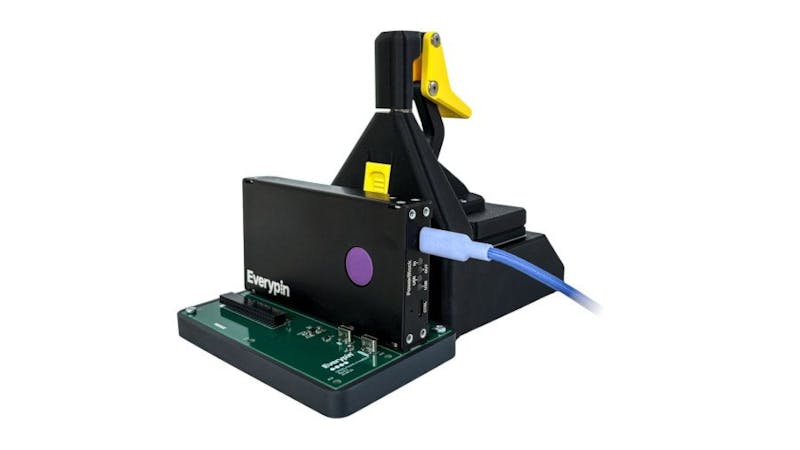
Two in the morning, forty boards left to test, and the routine never changes: unplug the DUT, count to three, plug it back in, watch the serial log, write down the number. Anyone who has run a batch test by hand knows the exact ache of that loop. Finnish firm Everypin built a box specifically to delete it.
A power supply that lives inside the jig
The PwrBlock 323 is a programmable DC supply sized to bolt into a test fixture instead of sitting beside it. One output channel covers 1–32V at up to 3A, topping out at 92W when fed from a USB Power Delivery source that can sustain 100W. Your test script sets the voltage, sets the current limit, switches the rail on or off, reads back what the board actually drew, and power-cycles the device under test without a human touching anything.
That framing is the interesting part. Bench PSUs are accurate but live on the desk and expect you to turn a knob. Cheap embedded buck modules mount anywhere but come with thin documentation and no real protection. The PwrBlock aims straight at the gap between them.
What is on the board
An STMicroelectronics STM32G0C1CEU runs the show, driving a Texas Instruments LM51722 buck-boost controller for the output stage. Measurement comes from an INA229 current and voltage monitor, and a TPS259830 eFuse sits in front as protection when a shorted DUT tries to take the rail down with it. Setting resolution is 10mV up to 24V, 20mV above that, and 1mA on current across the whole span.
Control is SCPI over USB, which is the detail that makes this usable in a school lab. SCPI is the same command grammar the big Keysight and Rigol instruments speak, so a Python script driving a PwrBlock looks almost identical to one driving a rack supply. Write VOLT 3.3 once and the muscle memory transfers. The enclosed unit measures 130×70×20mm with mounting points on multiple faces, so the same module can ride along from breadboard prototyping into a production fixture.
Worth watching, not yet worth ordering
It is on Crowd Supply at $230 per unit, described by its own creators as a working prototype, with shipping estimated for the end of March 2027. Treat that date the way you treat every crowdfunding date. The part that survives regardless is the idea: automated power control belongs inside the fixture, not on the bench next to it. If you are building a capstone test rig this term, wire a relay module and an INA219 to a spare ESP32 and script the same power-cycle loop for a few hundred pesos — you will learn exactly why Everypin bothered. Full writeup at Hackster.io.
Frequently Asked Questions
What voltage and current can the PwrBlock 323 actually deliver?
One DC channel from 1V to 32V at up to 3A, for a 92W ceiling, provided you feed it from a USB Power Delivery source that can hold 100W. Voltage steps in 10mV increments up to 24V and 20mV above that, and the current limit sets in 1mA steps across the full range.
How do you control it from a script?
It speaks SCPI over USB, the same command grammar used by bench instruments from Keysight and Rigol. That means plain Python, any VISA-compatible tool, or your own test harness can set voltage, set the current limit, toggle the output, read measurements back, and power-cycle the device under test in one sequence.
What will I learn if I build something like this?
Recreating the idea on a smaller budget teaches you buck-boost regulation, high-side current sensing with a chip like the INA219 or INA229, and overcurrent protection – three things most course labs skip. On the software side you will pick up instrument-style command parsing and writing Python that drives hardware unattended, which is exactly the skill set behind automated test engineering roles.
