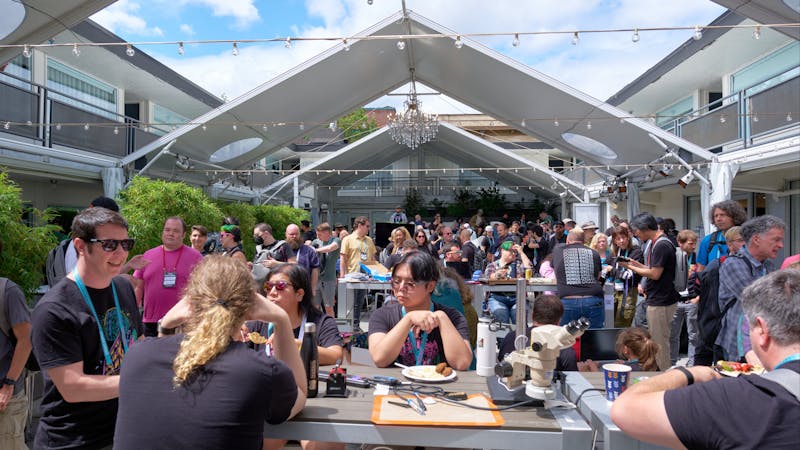
What happens when 450 hardware people book out a renovated 1960s motor lodge for a weekend? You get Teardown 2026, Crowd Supply’s annual open-hardware gathering, which moved this year from Portland’s Lloyd Center to the Jupiter Hotel and turned a conference into something closer to summer camp for people who solder.
So what actually happened there?
Four tracks, each named after a moon of Jupiter, carried 41 talks, workshops, and skill shares, plus 47 demo tables and installations. Shenzhen-based researcher Takasu-san opened the weekend by decapping a $30 chip pulled from $10 counterfeit AirPods, walking the room through what those parts reveal about China’s semiconductor supply chain. Seeed Studio founder Eric Pan followed the same thread from the other end: how a prototype on your bench becomes a product coming off a line.
Was any of it useful if you’re not in Portland?
Plenty of it. Keith Packard ran a masterclass on open-source C toolchains for embedded work, start to finish: building the compiler, flashing the target, emulating it when you have no hardware in front of you, all from the command line with no IDE anywhere in sight. Chloe Madison’s session dug into USB-C Power Delivery and how far you can push it in a maker project, which matters now that the EPR spec reaches 48 V and 240 W over one cable. And in the haptics workshop, Dillon Simeone dragged people past the usual vibration motor into solenoids, magnetic actuators, and Peltier cells, including the signal conditioning needed to make any of it feel like something.
The moment worth telling your robotics club about
Danielle Boyer’s day-two keynote covered her nonprofit, The STEAM Connection, which has put more than 8,000 DIY robot kits into the hands of Indigenous students. The kits run on an ESP32, and they are built around teaching Anishinaabemowin, an endangered language. Low-cost microcontroller, printed shell, curriculum designed by the students themselves. That is a model any ECE org or STEM department here could copy on a fraction of the budget.
Try this before next year’s ticket sales
Crowd Supply posts the talks to its YouTube channel after the event, so start there rather than waiting for a plane ticket. If you want a version you can run at your own school, the BedazzLED wearables workshop is the easiest to clone: an ESP32 board, WLED flashed to it, one addressable LED strip on a spare GPIO pin, and a breadboard per pair of students. Full event write-up is at Hackster.io.
Frequently Asked Questions
What was the biggest project showcased at Teardown 2026?
Danielle Boyer’s day-two keynote covered The STEAM Connection, which has distributed over 8,000 ESP32-based DIY robot kits to Indigenous students. The kits double as a tool for teaching Anishinaabemowin, an endangered language, so the hardware and the curriculum were designed together.
Do I need expensive gear to try the projects shown there?
No. The BedazzLED wearables workshop runs on an ESP32 board, WLED firmware, one addressable LED strip, and a breadboard. The haptics session used solenoids and Peltier cells, which cost more, but a plain vibration motor gets you started on the same signal-conditioning ideas.
What will I learn if I build this?
Flashing firmware like WLED onto an ESP32, wiring an addressable LED strip to a GPIO pin with the right level shifting and power budget, and reading a USB-C PD spec sheet to figure out how much current your project can actually pull. Those three skills carry straight into thesis work and robotics competitions.
