
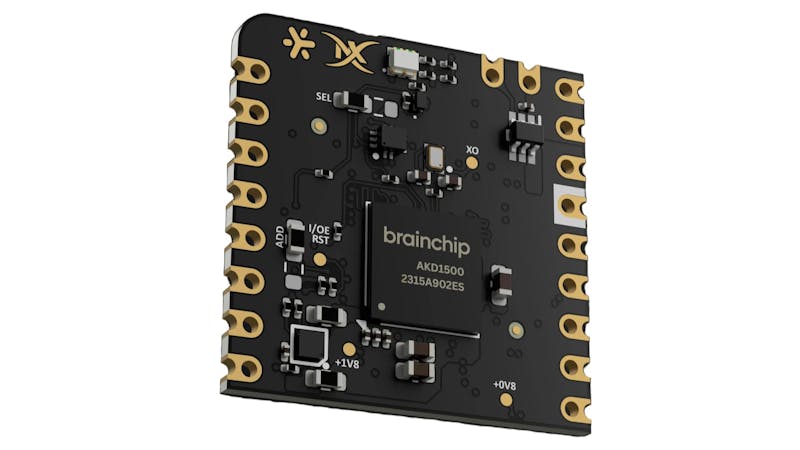
A battery-powered sensor node bolted to a lab wall, listening for one wake word, is a nice idea until you check the current draw. Run continuous CNN inference on an ordinary microcontroller and the coin cell is flat before the next class period. That power wall is exactly what BrainChip and Croatian hardware house Neuromorphyx went after with the BrainBoard1500.
What they built
The BrainBoard1500 is a development board wrapped around BrainChip’s AKD1500 neural accelerator, a neuromorphic part carrying 32 neural cores. The clever decision is the packaging. Most neuromorphic evaluation hardware ships as an M.2 or PCIe card that has to hang off a host PC, which is useless if your project lives on a robot chassis. Neuromorphyx put the silicon on an Arduino Nicla footprint instead, roughly 22.9 x 22.9 mm, so the accelerator sits right next to your sensors instead of across a desk from them.
How it wires into a build
Host communication runs over SPI or QSPI, with I2C handling system control. There is 4 MB of onboard flash for holding spiking neural network models, so the accelerator is not begging a host for weights every boot. Neuromorphyx ships an open source Arduino Nicla library and drivers, and because SPI and I2C are boringly standard, the same board should adapt to a Raspberry Pi, a Seeed XIAO, an OpenMV camera, an ESP32, or an STM32 host with wiring changes rather than a board respin. Watch your logic levels and pull-ups on the I2C lines as always.
The part worth pointing at is the onboard two-channel current monitor. Neuromorphic computing sells itself on power savings, and this is the first dev board in the family that lets you prove the claim without soldering in an INA219 breakout or clipping a bench multimeter into the supply rail. You can profile an inference run, then measure what your sleep and wake configuration actually costs, in the same sketch.
Takeaway
BrainChip is planning model repositories for keyword spotting, visual wake words, and human activity recognition, which covers a good chunk of what a capstone team would want anyway. The board sells directly through Neuromorphyx at launch. Full announcement is on Hackster: the BrainBoard1500 write-up. If you are scoping an always-on sensing thesis, do the cheap experiment first: put a multimeter on your current ESP32 rig at 3.3V, log the idle and inference draw for an hour, and you will know immediately whether a neuromorphic accelerator is solving your real problem or a made-up one.
Frequently Asked Questions
How does the BrainBoard1500 connect to a host microcontroller?
Inference data moves over SPI or QSPI, while I2C handles system control. Because both are standard interfaces, the board can be paired with a Raspberry Pi, ESP32, STM32, Seeed XIAO, or OpenMV host, not only an Arduino Nicla carrier.
Why does the board include a two-channel current monitor?
Neuromorphic accelerators are pitched on low power draw, so you need to measure it. The onboard monitor lets you profile inference, sleep, and wake current in real time without wiring in a separate INA219 breakout or a bench multimeter.
What will I learn if I build with this?
You will pick up spiking neural network basics, SPI and I2C bus wiring between an accelerator and a host MCU, model loading into onboard flash, and power profiling. That last skill transfers to any battery-powered project, from thesis sensor nodes to competition robots.
