
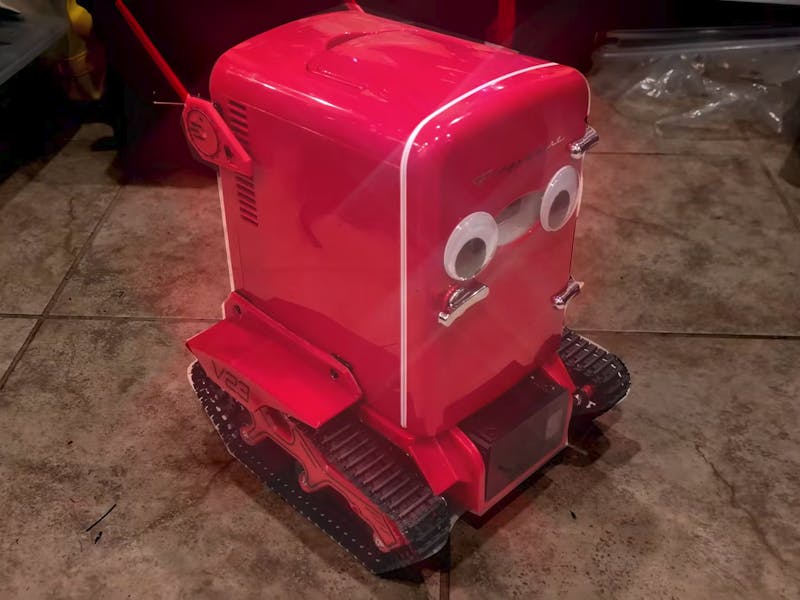
A refrigerator that chases you across the kitchen sounds like a party gag, but the wiring behind Dorian Todd’s runaway mini fridge is the same split-brain design that runs warehouse robots and self-driving research rigs. One processor thinks, a smaller one drives the motors, and a serial link keeps them honest. Get that split working and you can steer almost any autonomous project a school robotics team dreams up.
What Dorian actually built
The fridge rolls on a tank-style track drivetrain turned by two Repeat Robotics Ultra Mk2 brushless gear motors, the same units built for 12-pound combat robots. Todd first sketched a six-legged hexapod, then dropped the idea once he pictured a stomping gait sloshing every carbonated drink inside. Pick a mode and the fridge either trails about a meter behind you carrying a cold drink, or bolts the opposite direction the moment you reach for it.
The two-brain electronics
An NVIDIA Jetson Orin Nano Super running Ubuntu and ROS 2 Jazzy does the heavy thinking. A YOLO model accelerated with TensorRT spots people in real time, and the ROS 2 Nav2 stack builds a live obstacle map from a Manifold Tech Odin 1 module that supplies depth sensors, an RGB camera, an IMU, and onboard SLAM. The Jetson then hands off to an ESP32 acting as the robot’s spinal cord, sending a four-byte serial packet that carries the drive command and the door position. The ESP32 turns that into motor and servo signals, including a 25 kg-cm servo that swings the magnet-latched door open on cue.
Build a smaller version yourself
You do not need a Jetson to copy the pattern. Wire an ESP32 to a pair of motor drivers and one servo, then feed it short serial packets from a laptop or a Raspberry Pi running a lightweight person-detector. Keep every packet a fixed four bytes so a single dropped byte never desyncs the two boards, and tie your grounds together: Todd rewired the fridge’s cooling loop to a 12-volt supply, so the logic and power rails must share a common reference. Watch Todd’s full teardown on Hackster before you scale the idea up.
Frequently Asked Questions
What handles the runaway fridge’s navigation?
An NVIDIA Jetson Orin Nano Super running ROS 2 Jazzy does the sensing and planning. A YOLO model accelerated with TensorRT spots people, the Nav2 stack plots a path, and a Manifold Tech Odin 1 module feeds it depth sensors, an RGB camera, an IMU, and onboard SLAM.
Why does the robot use both a Jetson and an ESP32?
What will I learn if I build this?
You practice the split-brain robot pattern: coordinating a high-level compute board with a microcontroller over a fixed-length serial link, plus ROS 2 basics, motor and servo control, computer vision, and safe grounding between separate power rails.
