
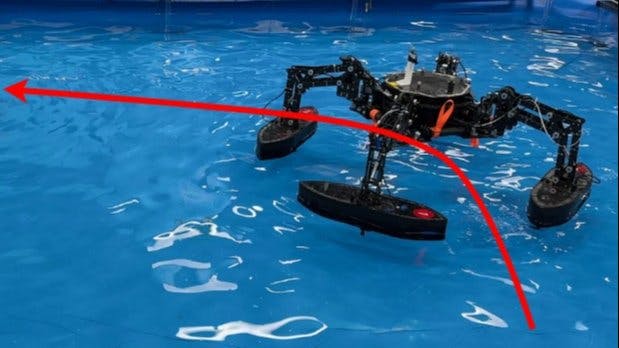
Search-and-rescue robotics keeps hitting the same wall. Drones and boats are good at finding a swimmer in trouble, but almost none of them do the actual pulling-out-of-the-water part, so responders still lose precious minutes. A research prototype called QuadBoat is aimed squarely at that gap, and it fits a bigger shift in the field toward robots that finish the rescue instead of just spotting it.
A robot that borrows from fishing spiders
QuadBoat takes its cue from fishing spiders, which skate across calm water on long, water-repellent legs that spread their weight over the surface. Instead of chasing surface tension, the team built a buoyancy-based surface vehicle with four articulated legs, each tied to an independently controlled outrigger hull. Every leg has several degrees of freedom, so the robot can extend, lift, rotate, and reposition to stay upright while it reaches a victim and lifts them clear of the water.
What is actually running the thing
The brains are a Raspberry Pi 4 Model B running the navigation software, with multiple Arduino boards handling the individual motors and joint controllers. Any robotics student will recognize that split: the Pi does the heavy vision and path planning, the Arduinos do the real-time motor work over a serial link. Cameras spot the target, inverse-kinematics math coordinates all four legs, and a cascaded MPC-PID controller keeps the platform on its trajectory. The four hulls supply roughly 55 kilograms of buoyancy, and two operating modes let it trade omnidirectional precision for higher-speed travel.
What to try next
You do not need a 55 kg rescue platform to learn from this. Start with a single-hull Pi 4 and Arduino boat: run OpenCV on the Pi to track a floating red ball, send steering commands over serial to an Arduino driving two small thrusters, and get a PID loop stable before you ever attempt MPC. For a thesis or robotics-club build, the genuinely tricky parts are the serial handshake between the Pi and the Arduino, and tuning the PID gains so the hull does not oscillate on choppy water. Read the full QuadBoat write-up at Hackster.io, then pick one subsystem to prototype this term.
Frequently Asked Questions
What controls QuadBoat’s four legs?
A Raspberry Pi 4 Model B runs the navigation and vision software while multiple Arduino boards drive the individual motors and joint controllers. Inverse-kinematics math and a cascaded MPC-PID controller coordinate all four articulated legs so the robot stays stable during a retrieval.
How does the robot find a person in the water?
Onboard cameras feed a computer-vision pipeline that identifies and tracks the rescue target. The four buoyant hulls give about 55 kilograms of lift, and thrusters plus the articulated legs let QuadBoat approach, grab, and tow the victim to safety.
What will I learn if I build a scaled-down version?
You will practice the classic split of a Raspberry Pi handling vision and planning while an Arduino handles real-time motor control over serial, plus PID tuning, basic OpenCV object tracking, and buoyancy math. It is a strong thesis or robotics-club project that touches embedded programming, control theory, and mechanical design at once.
