
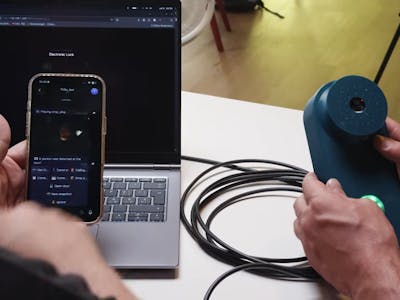
Local-first hardware is having a moment. As more makers get uneasy about every doorbell ping routing through a company’s servers, a wave of builds is pushing AI back onto the device itself. A privacy-focused smart doorbell from Arduino co-founder Massimo Banzi and the SuperModerno team lands right in that trend, and it is built entirely from off-the-shelf parts you can source yourself.
The build itself
At the core sits the Arduino UNO Q, a board that runs a full Linux OS so it can handle edge AI, host its own web dashboard, and talk to a custom Telegram bot without any cloud middleman. Video comes from a Sony IMX219 camera behind a fisheye lens for a wide view of the porch. Instead of streaming footage anywhere, lightweight models run on the UNO Q and only fire when someone lingers for a few seconds, snapping a single frame and pushing it to your phone over Telegram.
The rest of the hardware rides on Arduino’s Modulino ecosystem, where each small I2C module owns one job. A capacitive touch pad becomes the bell button behind a translucent panel, an audio module pairs a mic with an I2C amplifier, and a dedicated STM32 LED driver runs up to 25 addressable RGB LEDs without the timing glitches that plague LEDs driven straight off a Linux SBC.
The technical takeaway
The clever move here is splitting responsibilities across the I2C bus. Linux is great at running a neural net and a web server, but it is terrible at bit-banging precise LED timing, so that job goes to a separate STM32. A relay module handles the door latch on its own line, and every module can be swapped or reused in your next project because they share the same 3.3V I2C wiring. It is a solder-light, modular pattern worth copying: keep the messy real-time work off the CPU that is busy thinking.
What to try next
Start smaller. Wire a single IMX219 or Pi Camera to a person-detection model and log hits locally before you add a bell, a relay, or LEDs. Swap Telegram for MQTT if you already run Home Assistant. Watch your relay’s coil voltage against your board’s GPIO limits, and add a flyback diode so switching a latch does not brown out the camera. Full parts and wiring notes are in the original writeup: Hackster’s project page.
Frequently Asked Questions
How does this doorbell detect people without the cloud?
The Arduino UNO Q runs a lightweight person-detection model locally on its Linux OS. A Sony IMX219 camera feeds video in, and when someone stays in frame for a few seconds the board captures one snapshot and sends it over a Telegram bot, so no footage leaves the device.
What parts do I need to build one?
The core is an Arduino UNO Q, an IMX219 camera with a fisheye lens, and several I2C Modulino boards: a capacitive touch button, an audio module with an I2C amplifier, an STM32 LED driver for the RGB LEDs, and a relay module for an optional door latch.
What will I learn if I build this?
You’ll practice wiring an I2C bus with multiple modules, running edge-AI inference on a Linux single-board computer, and offloading real-time tasks like LED timing to a dedicated microcontroller. It’s a solid capstone for anyone studying embedded systems or IoT.
