
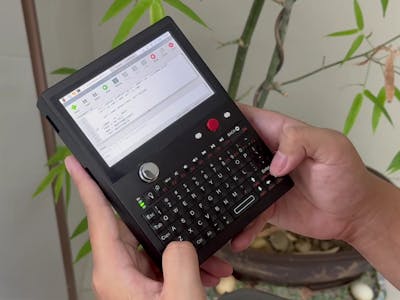
Pocket-sized Linux machines have been quietly multiplying over the past couple of years, and most of them share one flaw: they lock you into a sealed box you can use but never open. A small wave of open-hardware handhelds is pushing back on that, and the newest one, called Lini, leans into the idea by putting a Raspberry Pi Compute Module 5 at its core.
What the Lini actually is
Lini is a handheld computer about the size of a small tablet, built around the Raspberry Pi CM5 and compatible with the wider Pi ecosystem. A 4.3-inch QLED touchscreen handles the display, and a compact physical keyboard pairs with a ThinkPad-style TrackPoint so you can move a cursor without reaching for a mouse. The whole thing lives inside a CNC-machined aluminum shell measuring roughly 150 x 112 x 20 mm, and a 10,000 mAh battery keeps it running for a claimed six to eight hours.
The part makers will care about
Where most handhelds trim ports to stay thin, Lini goes the other way. You get dual USB 3.0 ports, full-size HDMI, USB-C, a microSD slot, and an M.2 M-key socket for NVMe storage. The feature that matters for hardware people is the full 40-pin Raspberry Pi GPIO header, backed by dedicated 6A power rails so you can actually drive hungry HATs instead of browning them out. That turns the device into a portable bench: a Linux workstation, an embedded dev target, and a sensor-wiring playground in one aluminum slab.
Where to take it next
The creators plan to release the full hardware design files, schematics, and source code once the first crowdfunding rewards ship, so this becomes a platform you can study and repair rather than a gadget you toss. It is live on Kickstarter now at $160 without a CM5 or $254 with a 4 GB module, shipping December 2026. If you are a student or club without that budget, the same idea scales down: pair a Pi Zero 2 W with a small SPI display and a LiPo, break out the GPIO header, and you have prototyped the concept for a fraction of the cost. The full write-up with photos is on Hackster if you want the deeper look before backing it.
Frequently Asked Questions
What hardware powers the Lini handheld?
A Raspberry Pi Compute Module 5 sits at the core, paired with a 4.3-inch QLED touchscreen, a physical keyboard with a ThinkPad-style TrackPoint, and a 10,000 mAh battery rated for six to eight hours in a CNC-machined aluminum case.
How much does the Lini cost and when does it ship?
On Kickstarter it runs $160 without a CM5 or $254 with a 4 GB module bundled in. The creators expect orders to ship by December 2026, after which they plan to release the schematics and source files.
What will I learn if I build a Pi handheld like this?
You will pick up GPIO wiring on the 40-pin header, power budgeting for 6A rails and HATs, NVMe and microSD storage setup, and how to assemble a self-contained Linux device. Prototyping a cheaper version with a Pi Zero 2 W and an SPI display teaches the same skills for less money.
